Investments in commercial real estate in Moscow City: is it worth investing in 2026
Investments in commercial real estate in Moscow City — one of the most resilient instruments for preserving and multiplying capital in the Russian market. Amid economic turbulence, high inflation, and financial market instability, office real estate in the western direction of Moscow demonstrates record-low vacancy rates, steady rental rate growth, and stable demand from the largest Russian corporations. This article provides a detailed analysis of the investment potential of Moscow City commercial real estate: current market data, property types, prices, yields, risks, and why the unique assets on the top floors of the Federation Tower fall into the "trophy" category.
Moscow City as an investment asset: why it works
Over 25 years, the Moscow City business center has transformed from an ambitious construction project into a mature, established office cluster with a solid reputation. It houses the headquarters of VTB, Transneft, Ozon, Russian ministries and departments, and dozens of large domestic and international companies. Such a composition of tenants and owners provides a highly stable foundation for investments: large corporations do not change their address at the first signs of economic turbulence.
According to a study by Commonwealth Partnership (CMWP) for the first three quarters of 2025, the western direction of Moscow — including Moscow City — demonstrates the highest rental rates and fastest growth among all office clusters in the capital. This applies to all classes: Prime, A, and B. This trend has remained stable over several years and is not merely circumstantial.
The fundamental reason for Moscow City's attractiveness to investors is a structural supply deficit amid sustained demand. There are virtually no new development plots left within the existing City, while business demand for offices here is only growing. This is a classic scenario where asset values possess long-term growth potential.
The market in numbers: vacancy, rates, demand
Vacancy at a historic low
According to Maria Zimina, Partner and Director of the Office Real Estate Department at NF Group, Moscow City has recorded the lowest vacancy rate in the entire history of the complex. Finding willing sellers of attractive properties here is extremely difficult — the market has turned into a seller's market.
According to CORE.XP analysts, as of September 2025, the share of vacant offices in the "Greater City" zone — including the territories adjacent to the classic City — stood at under 1,9%, or about 41 thousand sq. m. To understand the dynamics: at the beginning of 2023, the figure was 6.5%, by the beginning of 2024 it had halved to 3%, and by the end of 2025, it is approaching the technical minimum. Such a contraction of supply amid growing demand is one of the strongest arguments in favor of investing in this cluster.
Rental rate growth
Rental rates for offices in Moscow City and adjacent territories are steadily increasing. According to NF Group, average rental rates for flexible offices in "Greater City" have reached 56,300 rubles per sq. m per year and are growing by 35.3% annually — one of the highest growth rates in the Moscow commercial real estate market.
For standard office blocks in new properties in the western direction of Moscow, rental rates without finishing (shell & core) range from 45,000 to 55,000 rubles per sq. m per year, and with full finishing — from 50,000 to 60,000 rubles. In Moscow City itself — especially on the upper floors of flagship towers — rates are significantly higher, reaching up to 180,000 rubles per sq. m per year.
Demand dynamics
While in 2020 the western direction of Moscow accounted for about 18% of total office demand in the capital, by 2023–2025 this figure grew to approximately 36%, according to CORE.XP data. Demand does not decrease even as available supply is exhausted — it redirects to adjacent territories, driving the development of "Greater City".
A significant portion of the executive staff of large companies resides in the western districts of Moscow. This creates a sustainable structural demand for offices specifically in this area — regardless of broader economic conditions.
Types of investment properties in Moscow City
Small office blocks (75–300 sq. m)
The most liquid segment of the Moscow City commercial real estate market. High demand from small and medium-sized businesses, quick leasing turnaround, and a transparent secondary resale market. Entry point — from tens of millions of rubles. Suitable for investors focused on rental income with a relatively short return on investment horizon.
The main limitation is competition: there are relatively more of such properties on the market than large blocks or unique assets.
Standard office blocks and entire floors (300–2,000+ sq. m)
An instrument for major investors and companies considering an office as a long-term balance sheet asset. The cost of an entire floor in the Federation or OKO towers ranges from several hundred million to a billion rubles and above. Liquidity is lower than that of small blocks, but competition during resale is minimal, and tenants are primarily large businesses with long-term contracts.
For companies, this format offers the opportunity to secure the asset on their balance sheet and gain the operational benefits of owning their own office in the country's most prestigious business center.
Trophy assets — unique properties with no equivalents
A separate and highly intriguing category from an investment perspective — one-of-a-kind properties that cannot be replicated. Their value is determined not only by square meters but by status, uniqueness, and the impossibility of creating a competing equivalent.
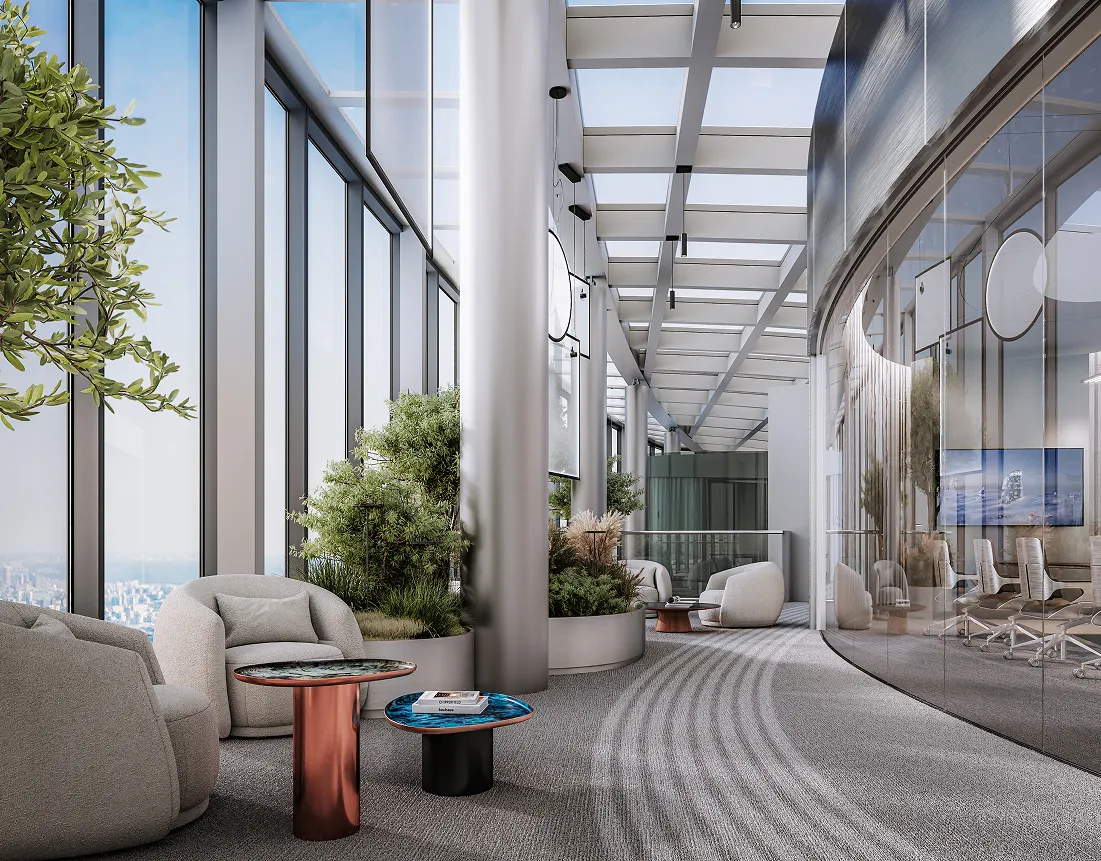
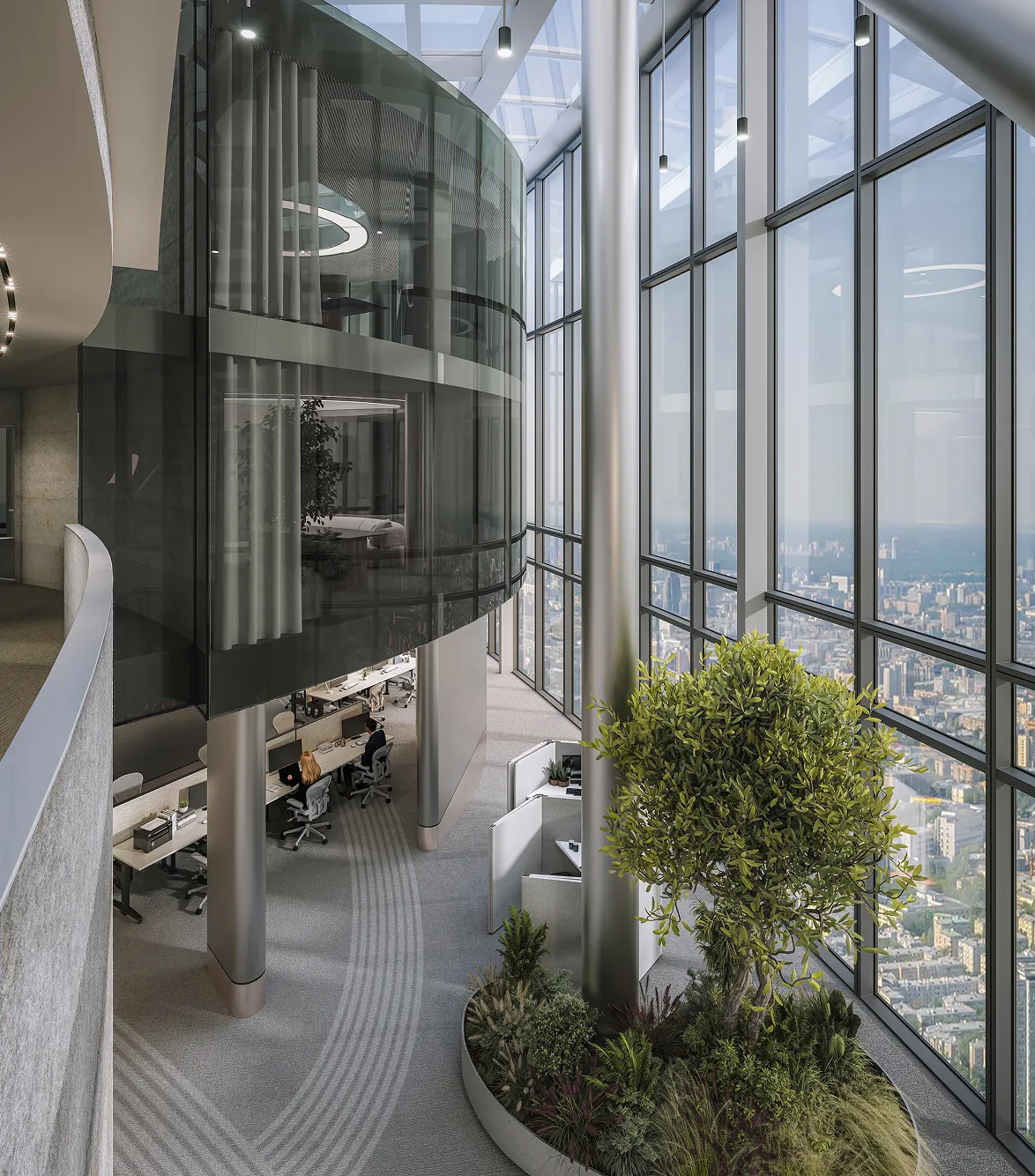
It is exactly to this category that F-375 office penthouse in the Federation Tower belongs: a tri-level space of 2,642 sq. m under a 14-meter glass dome on the 93rd–95th floors of the Vostok Tower — at an altitude of 360–370 meters above Moscow. The price is 4.16 million rubles per sq. m. This is the highest office in Europe and the first office property of this format in Russia.
Commercial real estate analysts classify such assets as «collectible» — properties with a pronounced image status, high investment appeal, and significant appreciation potential. The choice of such properties is dictated not only by the prestige factor but also by strict investment logic: unique assets in an exhausted supply market always appreciate faster than the market average.
Why Moscow City cannot be replaced by "Greater City"
The development of the territories adjacent to Moscow City — the "Greater City" in western Moscow — is actively underway. Projects announced for construction between 2025 and 2030 account for 35% of the total volume of office construction in Moscow. The Kutuzovsky business corridor, business centers near Kuntsevskaya, and new projects along the Third Transport Ring (TTK) attract investors with affordable entry prices and growth prospects.
However, the classic Moscow City holds a fundamental advantage that cannot be reproduced: an established status and a 25-year history. An address on the Presnenskaya Embankment in the Federation or OKO towers is not just an office. It is an affiliation with a specific league of business that cannot be bought in a new business center on the periphery, no matter how modern it may be.
This is precisely why demand for properties in the classic Moscow City will not decline even as "Greater City" is developed — these are fundamentally different products for fundamentally different buyers.
Investment risks: what is important to consider in advance
LOW LIQUIDITY OF LARGE BLOCKS. An office over 500 sq. m is not an apartment that can be sold in a month. The pool of potential buyers is narrow, and transactions take anywhere from several months to a year. When investing in large properties, a planning horizon of at least 5–7 years is required.
OPERATIONAL EXPENSES. The cost of renting or owning an office in Moscow City does not include operational fees, utility bills, or parking. These must be factored into the financial model when calculating the true investment yield.
TENANT QUALITY. For an investor acquiring a property for leasing purposes, a key parameter is the reliability of the tenant and the duration of the contract. A long-term lease with a large, systematically important company fundamentally changes the investment risk profile.
Legal due diligence. Some properties in Moscow City are sold through complex corporate structures. Legal due diligence and support from a qualified commercial real estate lawyer are absolute prerequisites before any transaction.
CHANGES IN MARKET CONDITIONS. The current growth in rates is not guaranteed forever. However, the structural supply deficit in Moscow City creates a solid foundation for maintaining high demand over a horizon of at least 5–10 years.
How to choose an investment property in Moscow City
DETERMINE YOUR INVESTMENT HORIZON. Small blocks up to 300 sq. m are a more liquid instrument with a shorter horizon. Large blocks and unique properties represent long-term investments with higher capital appreciation potential.
EVALUATE THE FLOOR AND VIEW. The higher the floor, the more expensive the property and the higher its value growth potential. Offices with views of the Moskva River, the historic center, and the western panorama consistently appreciate faster than comparable properties without panoramic views.
CHECK THE PROPERTY MANAGEMENT COMPANY. The quality of the tower's management directly affects tenant comfort and, consequently, vacancy levels and rental rates in the long term.
CONSIDER UNIQUE PROPERTIES. Trophy assets in a deficit market always appreciate faster than standard offerings. If your investment horizon and budget allow, a unique property with no equivalents provides a fundamentally different investment profile.
Frequently Asked Questions
Is it profitable to invest in Moscow City offices in 2026?
Yes. According to analysts, Moscow City demonstrates record-low vacancy and rental rate growth of up to 35% annually. A supply deficit coupled with sustained demand creates a long-term foundation for property value appreciation.
What is the rental yield for an office in Moscow City?
Rental rates in Moscow City range from 35,000 to 180,000 rubles per sq. m per year, depending on the tower and floor. The average rate growth in 2025 was 35.3% in the flexible office segment. Actual yield depends on contract terms and operational expenses.
What is a trophy asset in real estate?
A trophy asset is a one-of-a-kind property with a pronounced prestige status and high appreciation potential. In Moscow City, the ultimate example is the F-375 office penthouse on the 95th floor of the Federation Tower: 2,642 sq. m under a glass dome at an altitude of 370 meters, with no equivalents in Europe.
What is the minimum budget for investing in Moscow City?
Entry into the Moscow City commercial real estate market starts from tens of millions of rubles for small office blocks. Entire floors start from several hundred million. Unique trophy properties range up into the billions of rubles.
How does investing in Moscow City differ from "Greater City"?
The classic Moscow City is an established prestigious address with a 25-year history, record-low vacancy, and maximum high rates. "Greater City" offers a more accessible entry point and a higher potential for growth from scratch, but lacks the established status. These are different products for different investment strategies.
In brief: why Moscow City remains the premier investment choice
- VACANCY — historic low, under 2% across the cluster as of September 2025
- RATE GROWTH — up to 35.3% annually in the flexible office segment in the western direction
- RELIABLE TENANTS — VTB, Transneft, Ozon, government entities
- SUPPLY DEFICIT — there are virtually no zones left for new development within the City
- TROPHY PROPERTIES — unique assets on the top floors of the Federation Tower with no equivalents in Europe
Considering investing in Moscow City commercial real estate? Learn more about is the F-375 office penthouse on the 95th floor of the Federation Tower — a trophy asset that experts classify as a world-class "collectible" property.