History of Moscow City
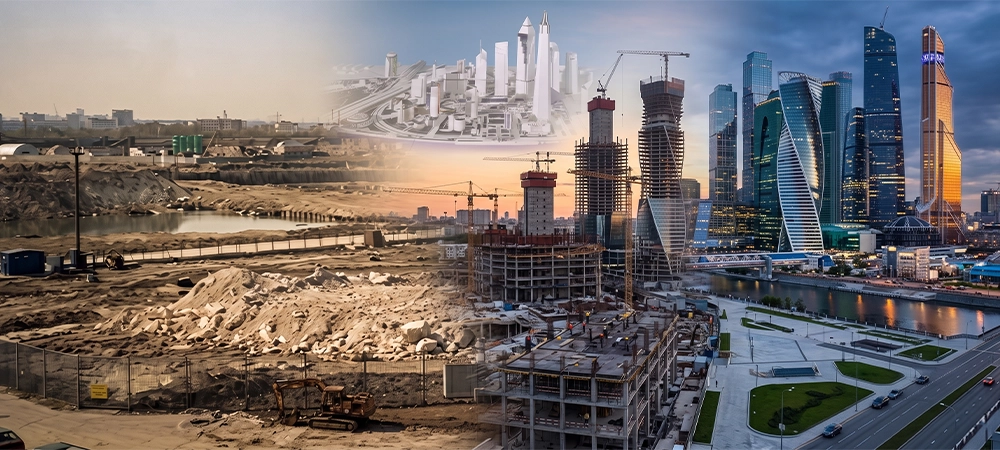
Moscow City — one of the most ambitious urban development projects in the history of Russia. Over 30 years, a wasteland on the site of former quarries near the Presnenskaya Embankment has transformed into a world-class business district with skyscrapers reaching up to 374 meters in height. The history of Moscow City is a story of records, scandals, freezes, and triumphs. Here is how it all began and what is being built today.
How the idea of Moscow City was born
The idea of creating the Moscow business center was born in 1991. Architect Boris Ivanovich Tkhor , together with five colleagues, developed the concept of the future MIBC and proposed to the city authorities to transform the industrial zone near the Expocentre on the Presnenskaya Embankment into a modern business district.
The original vision was strict and elegant: 20 development plots, a green park area in the center with underground parking beneath it, and skyscrapers along the perimeter in the shape of a horseshoe with gradually increasing height — like a spiral. The tallest was supposed to be the Russia Tower, reaching a height of 612 meters.
In practice, things turned out differently. The central park gave way to the Afimall City shopping center, the Russia Tower was canceled, and the total area of the facilities almost doubled as investors dictated their terms. Nevertheless, the project became a reality and exceeded the boldest expectations.
Chronology of Moscow City construction
1991–1995 — Birth of the project
In 1991, Boris Tkhor presented the concept of the business center to the city authorities. In 1992, the management company OJSC City (now PJSC City) was established, which to this day manages and develops the MIBC and acts as the land lessee for the entire complex. The company is owned by the Solvers group.
In 1993, preparatory work began: clearing the territory and developing the documentary base. By the mid-1990s, construction officially started on the site of the former stone quarry near the Presnenskaya Embankment.
In 1995, the project was frozen due to a lack of funding — for more than seven years.
1996–2001 — The first facilities
In 1996, construction began on the first two facilities — the Bagration pedestrian bridge and Tower 2000, following the original design by Boris Tkhor. These two structures became the only ones built exactly according to the initial master plan.
In In 1997, the Bagration Bridge was completed for the 850th anniversary of Moscow. It has a length of 214 meters, a width of 16 meters, and a height of 14 meters. It features two levels: the lower level is fully glazed and occupied by a shopping gallery with an area of 2,572 sq. m, while the upper level is an open observation terrace overlooking the entire business district and the Moskva River. In terms of functionality, the Bagration Bridge has no equals in all of Russia.
In In 2001, Tower 2000 was completed — the first skyscraper in Moscow City. It has a height of 130 meters and 34 floors, fully dedicated to office spaces. It is the only tower of the City located on the right bank of the Moskva River.
2003–2009 — Major construction
In 2003, investor interest in the project sharply increased, and construction resumed with renewed vigor.
2003–2007 — Construction of the Naberezhnaya Tower complex by the Turkish company ENKA. It consists of three buildings with heights of 17, 27, and 60 floors, connected by a retail concourse. In 2007, the block reaching 268 meters became the tallest building in Russia and Europe. Total investments amounted to 200 million dollars.
2004 — Start of construction on the Federation Tower complex. A foundation slab consisting of 14 thousand cubic meters of concrete was poured — a record listed in the Guinness Book of Records..
2005–2009 — Construction of the City of Capitals mixed-use complex. It comprises two skyscrapers: Moscow (73 floors, 302 meters) and St. Petersburg (65 floors, 257 meters), unified by a 17-story podium. In 2010, the Moscow Tower entered the top 10 best skyscrapers in the world according to the Emporis Skyscraper Award. In 2012, City of Capitals took first place among European skyscrapers on the SkyscraperCity forum.
2006–2011 — Construction of the Imperia business complex. It features 60 floors and a height of 238.6 meters, built around the concept of a "vertical city" integrating offices, residential apartments, and commercial spaces.
2011 — Opening of the Afimall City shopping center. It spans six floors with a total area of 316,832 sq. m, housing around 500 stores and restaurants. The construction cost was 300 million dollars.
2008–2015 — Records and new heights
2008–2014 — Construction of the Eurasia Tower. It is the only steel-framed tower in Moscow City — all others are made of concrete. Height is 309 meters, 72 floors. Accommodates offices, restaurants, a hotel, and apartments.
2008–2014 — Construction of the Evolution Tower. Each of its 51 floors is twisted by 3 degrees, giving the building a total spiral twist of 156 degrees. The architectural design was inspired by the Yin-Yang symbol and Auguste Rodin's sculpture The Kiss. In 2015, the Evolution Tower became a finalist in the CTBUH Awards for "Best Tall Building Europe".
2009–2013 — Construction of the Mercury Tower. Features 75 floors and a height of 338.8 meters. In 2013, while still under construction, Mercury became the tallest building in Europe, surpassing London's The Shard. Estimated cost ranges from 650 million to 1 billion dollars.
2010–2016 — Construction of the IQ-quarter. Consists of three towers on Plot 11, spanning 228,000 sq. m. Serves as the primary transport and interchange hub of Moscow City.
2012–2016 — Construction of the OKO mixed-use complex. Features the South Tower (85 floors, 354 meters) and the North Tower (49 floors, 245 meters). Includes the largest underground parking facility in Europe with a capacity of 3,400 spaces.
2014–2017 — Federation Tower: the main record
On November 25, 2014 , the under-construction Vostok Tower of the Federation complex reached the 343-meter mark, becoming the tallest building in Russia and Europe.
On November 15, 2017 the Federation Tower was fully commissioned into operation. It stands at 374 meters with 95 above-ground floors. The CTBUH officially recognized it as the tallest skyscraper in Europe. The architects are Sergei Tchoban and Peter Schweger. Total construction cost reached 1.2 billion dollars.
In In 2019 the Federation Tower won the Grand Prix at the International Property Awards as the "World's Best Property".
Today, floors 93–95 of the Vostok Tower house F-375 office penthouse — a tri-level commercial space under a spectacular glass dome at an altitude of 370 meters. It is the highest office space in Europe.
2018–2026 — A new generation
2018 — Start of construction on Capital Towers: three residential towers ranging from 212 to 270 meters in height.
2019–2020 — Construction and delivery of Neva Towers: two skyscrapers (79 and 68 floors, featuring 848 apartments in the first phase).
2019 — Start of construction on One Tower: planned at 109 floors and 442.8 meters. Upon completion, it will become the tallest residential building in Europe..
2020 — Start of construction on iCity: two office skyscrapers, Time Tower (141.2 m) and Space Tower (256.7 m).
2024 — Completion of Moscow Towers (formerly Grand Tower). Start of construction on Dom Dau — an 85-story premium residential complex.
2025 — Approval of the project for the Wildberries & Russ business center near the Bagration Bridge. Approval of the updated concept for One Tower — redesigned as two towers up to 91 floors connected by a glass skybridge.
2026 — Approval of the Aurus Residences project: two skyscrapers reaching up to 395 meters (up to 96 floors), scheduled for completion in 2031. The broader "Greater City" project is approximately 80% implemented.
Architects and investments
Moscow City does not adhere to a single architectural style — each skyscraper was designed by an independent architect or firm. Prominent contributors include Boris Tkhor, Sergei Tchoban, Peter Schweger, Mikhail Posokhin, Frank Williams, Tony Kettle, NBBJ, Skidmore, Owings & Merrill, ENKA, SPEECH, and others.
The total volume of investment in Moscow City has exceeded 12 billion US dollars..
Frequently Asked Questions
When was Moscow City built?
Construction of Moscow City officially began in 1996. The first facility — the Bagration Bridge — was completed in 1997 for the 850th anniversary of Moscow. The first skyscraper — Tower 2000 — was commissioned in 2001. As of 2026, the overall project is approximately 80% complete.
Who designed Moscow City?
The idea for the Moscow business center was originally proposed by architect Boris Ivanovich Tkhor in 1991. He developed the initial master concept and suggested redeveloping the industrial zone along the Presnenskaya Embankment into a modern business district.
Which building in Moscow City is the tallest?
The tallest building in Moscow City is the Vostok Tower of the Federation complex, standing at 374 meters with 95 above-ground floors. It is currently the second-tallest building in Europe after the Lakhta Center in St. Petersburg.
How many towers are there in Moscow City?
To date, over 15 major complexes have been built in Moscow City. In total, under the broader "Greater City" expansion program, more than 23 major developments are planned, and construction is ongoing.
How much did the construction of Moscow City cost?
The total volume of investment has exceeded 12 billion dollars. The most expensive developments are the Federation Tower ($1.2 billion) and the Mercury Tower ($650 million to $1 billion).
Why is Moscow City called the Russian Manhattan?
Moscow City earned the nickname "Russian Manhattan" due to its concentration of skyscrapers within a single commercial district — drawing a parallel with the business center of New York. The complex unites corporate offices, residential housing, dining, and entertainment spaces as a vertical city.
In brief: history of Moscow City by dates
- 1991 — Architect Boris Tkhor proposed the concept of the MIBC
- 1997 — Bagration Bridge completed, the first facility of the complex
- 2001 — Tower 2000 completed, the first skyscraper in the City
- 2007 — Naberezhnaya Tower became the tallest building in Russia and Europe
- 2013 — Mercury Tower surpassed London's The Shard
- 2014 — Federation Tower became the tallest building in Russia and Europe
- 2017 — Federation Tower completed: 374 meters
- 2019 — Named "World's Best Property" by the International Property Awards
- 2026 — "Greater City" project is 80% implemented, construction continues
— "Greater City" project is 80% implemented, construction continues F-375 office penthouse: a tri-level commercial space under a glass dome at an altitude of 370 meters. The highest office space in Europe.