The Tallest Buildings in Russia: Skyscraper Rankings, Heights and Floor Counts

Russia has firmly established itself among the world’s leading countries in high-rise construction. Today, the country has dozens of completed skyscrapers, including the tallest building in Europe. From the first Stalinist high-rises to the supertall towers of Moscow-City and skyscrapers in other Russian regions, the country’s high-rise architecture has come a long way. In this guide, we present a comprehensive ranking of the tallest buildings in Russia, exploring their heights, floor counts, locations and history. We also look at where the towers of Moscow-City and Europe’s highest office stand in the ranking.
What Qualifies as a Skyscraper and How Many Are There in Russia?
A skyscraper is generally defined as a building at least 100 metres tall. Buildings exceeding 300 metres are classified as supertall. The world’s first skyscraper is widely considered to be Chicago’s Home Insurance Building, completed in 1885. At just 42 metres tall, it was nevertheless a major architectural breakthrough for its time.
The history of high-rise construction in Russia began in 1913 with a seven-storey apartment building in Moscow. Today, Russia holds a prominent position in global high-rise rankings, with dozens of skyscrapers completed across the country. Most are concentrated in Moscow, particularly within the Moscow-City business district. However, high-rise buildings can also be found in other regions, including Yekaterinburg.
Ranking of the Tallest Buildings in Russia
The table below presents the tallest buildings in Russia as of 2026.
| Rank | Building | City | Height | Floors |
| 1 | Lakhta Center | St Petersburg | 462 m | 87 |
| 2 | Federation Tower East | Moscow | 374 m | 95 |
| 3 | OKO South Tower | Moscow | 354 m | 85 |
| 4 | Mercury City Tower | Moscow | 339 m | 75 |
| 5 | Eurasia | Moscow | 309 m | 70 |
| 6 | City of Capitals — Moscow Tower | Moscow | 302 m | 76 |
| 7 | Naberezhnaya Tower C | Moscow | 268 m | 59 |
| 8 | Residential Building on Chapayevsky Lane | Moscow | 264 m | 57 |
| 9 | City of Capitals — St Petersburg Tower | Moscow | 257 m | 65 |
| 10 | Evolution Tower | Moscow | 255 m | 54 |
| 11 | OKO North Tower | Moscow | 245 m | 49 |
| 12 | Federation Tower West | Moscow | 243 m | 63 |
| 13 | Imperia Tower | Moscow | 239 m | 60 |
| 14 | House on Mosfilmovskaya | Moscow | 213 m | 53 |
| 15 | Iset Tower | Yekaterinburg | 209 m | 52 |
The overwhelming majority of Russia’s tallest buildings are located in Moscow-City. The undisputed leader stands in St Petersburg, while the only regional building near the top of the ranking is Yekaterinburg’s Iset Tower.
Lakhta Center: The Tallest Building in Russia and Europe
The undisputed leader in the ranking, and the tallest building not only in Russia but anywhere in Europe, is the 462-metre Lakhta Center in St Petersburg. Designed by the British architectural firm RMJM, the tower features a twisting glass façade that rises into a needle-like spire. Completed in 2019, the building serves as the headquarters of Gazprom.
Lakhta Center was deliberately constructed away from the historic centre of St Petersburg to preserve the city’s UNESCO-protected low-rise skyline. It is the only Russian building taller than Moscow’s skyscrapers and the only European skyscraper among the world’s 20 tallest buildings.
The Stalinist High-Rises: Where Russia’s Skyscraper Story Began
Before examining the towers of Moscow-City, it is worth looking back at the first generation of Soviet high-rises. Seven monumental buildings were constructed in Moscow between the late 1940s and the 1950s. They are commonly known as the Seven Sisters or the Stalinist high-rises. Eight buildings were originally planned, but the tallest of them, the Palace of the Soviets, was never completed.
| High-rise | Height | Floors |
| Main building of MSU | 240 m | 36 |
| Hotel «Ukraina» | 206 m | 34 |
| BUILDING ON KOTELNICHESKAYA EMBANKMENT | 176 m | 32 |
| MFA BUILDING | 172 m | 27 |
| BUILDING ON KUDRINSKAYA SQUARE | 156 m | 24 |
| Building near the Red Gates | 138 m | 24 |
| Leningradskaya Hotel | 136 m | 17 |
Main building of MSU on Sparrow Hills, including its spire, reaches a height of 240 metres. It became the tallest building in Europe and held the title for 37 years. Its structural frame and foundations were designed by Nikolai Nikitin, who later created the Ostankino Television Tower. Because of the weak ground conditions, he used a box foundation and introduced several innovative engineering solutions. The building has 36 floors and approximately 68 lifts.
Hotel «Ukraina» standing 206 metres tall, was recognised as the largest hotel in Europe when it opened in 1957. Today, it operates as the Radisson Collection Hotel, Moscow.
BUILDING ON KOTELNICHESKAYA EMBANKMENT 176-metre was conceived as a “city within a city”. MFA BUILDING on Smolenskaya Square is the only one of the Seven Sisters without a star on its spire. The buildings on Kudrinskaya Square and near the Red Gate, together with the Leningradskaya Hotel, complete the group of seven.
An interesting fact: the Red Gate Building was constructed at the same time as the metro station beneath it. To ensure that the building would stand upright after the ground settled, it was deliberately built at a calculated angle, while the surrounding soil was frozen. Once the ground thawed, the building settled and became vertical. This unique construction method has never been used anywhere else.
Moscow-City: Home to Most of Russia’s Skyscrapers
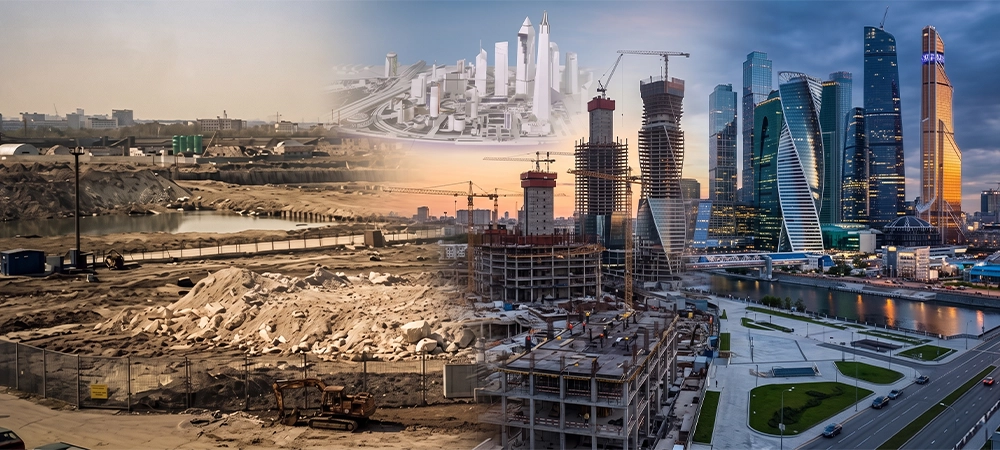
Russia’s main high-rise cluster is the Moscow International Business Centre, commonly known as Moscow-City. Architect Boris Tkhor first proposed the concept in 1992, while active construction began around 2005. Today, the towers of Moscow-City occupy most of the leading positions in the ranking of Russia’s tallest buildings.
Federation Tower East — 374 m
Federation Tower East is the tallest building in Moscow and the second-tallest in both Russia and Europe. It has 95 floors and reaches a height of 374 metres. The tower was designed by Sergei Tchoban and Peter Schweger. Its foundations required 14,000 cubic metres of concrete, an achievement recorded in the Guinness World Records. The towers are supported by 25 perimeter columns, while high-strength steel outrigger floors installed every 25–30 storeys provide additional stability. Federation Tower has 67 lifts. At its summit, on floors 93–95, is the F-375 office penthouse — the highest office in Europe.
OKO South Tower — 354 m
The second-tallest building in Moscow has 85 floors and reaches a height of 354 metres. Beneath the building are 15 levels of underground parking. The OKO complex also includes the 245-metre North Tower and combines apartments, offices and a rooftop observation deck.
Mercury City Tower — 339 m
Mercury City Tower has 75 floors and reaches a height of 339 metres. When completed, it was the tallest building in Europe. The project was designed by Frank Williams, responsible for more than 20 buildings in Manhattan, and Mikhail Posokhin, who oversaw the reconstruction of the Cathedral of Christ the Saviour. The underground section extends five levels below ground.
Eurasia — 309 m
Eurasia has 70 floors and stands 309 metres tall. The building contains offices, shops and a fitness centre.
City of Capitals — 302 m
The complex consists of two towers: Moscow, with 76 floors and a height of 302 metres, and St Petersburg, with 65 floors and a height of 257 metres. They are connected by an 18-storey section and contain both offices and residential apartments.
Naberezhnaya Tower — 268 m
Naberezhnaya Tower is a complex of three buildings standing 85, 127 and 268 metres tall. Before City of Capitals was completed, its tallest building held the title of Europe’s highest skyscraper. The complex is home to the offices of major international companies.
Evolution Tower — 255 m
Evolution Tower has 54 floors and reaches a height of 255 metres. Its distinctive twisting form resembles a DNA spiral, making it one of the most visually striking towers in Moscow-City.
Imperia — 239 m
Imperia Tower has 60 floors and reaches a height of 239 metres. It contains offices, apartments and retail premises and is served by 30 lifts.
Russian Skyscrapers Outside Moscow-City
High-rise construction in Russia is not limited to the capital’s main business district.
Residential Building on Chapayevsky Lane in Moscow stands 264 metres tall and has 57 floors. It ranks among the country’s tallest buildings and was designed in the Stalinist Empire style, creating a visual connection with Moscow’s historic high-rises.
House on Mosfilmovskaya in Moscow reaches a height of 213 metres and has 53 floors. Designed by architect Sergei Skuratov, it was named one of the world’s best skyscrapers in the 2012 Emporis Skyscraper Award.
Iset Tower in Yekaterinburg stands 209 metres tall and has 52 floors. It is the tallest residential building in the Urals and demonstrates that Russian skyscraper construction extends beyond Moscow.
Vysotsky Tower in Yekaterinburg reaches a height of 188 metres and has 54 floors. It was named after Vladimir Vysotsky with the permission of his family, and a museum dedicated to the actor, poet and musician operates on its second floor.
Moscow is also home to several other high-rise residential complexes, including Tricolor at 192 metres, Vorobyovy Gory at 188 metres, Continental at 184 metres, Alye Parusa at 179 metres and Edelweiss at 176 metres.
The Evolution of High-Rise Construction in Russia
Russian high-rise architecture has passed through several distinctive stages, each with its own architectural style.
The early 20th century. The first multi-storey apartment buildings appeared, marking Russia’s initial and relatively modest attempts to build upwards.
Stalinist Empire architecture, 1947–1957. Seven monumental high-rises with spires and elaborate decorative features were constructed in Moscow. The Main Building of Moscow State University remained the tallest building in Europe for 37 years.
Soviet modernism. High-rise residential buildings and hotels were constructed using simpler and more functional architectural forms.
The modern era, from the 2000s to the present day. This is the age of glass and steel, represented by Moscow-City, Lakhta Center and skyscrapers in Russia’s regions. During this period, Russia reached new international heights by constructing the tallest building in Europe.
Russia in the Global Skyscraper Landscape
Russia is represented in the global ranking of the world’s tallest buildings by Lakhta Center, which stands among the top 20. Its position is particularly strong by European standards: Lakhta Center is the tallest building on the continent, while Federation Tower ranks second in Europe.
Although Russian skyscrapers are not as tall as Asian giants such as Burj Khalifa at 828 metres or Shanghai Tower at 632 metres, Moscow and St Petersburg form the most impressive high-rise skylines in Europe. Russia also holds the undisputed European record in one category: the highest office in Europe is located in Moscow.
Europe’s Highest Office: F-375 in Federation Tower
At the top of Federation Tower, the second-tallest building in Russia, is is the F-375 office penthouse — the highest office in Europe.
F-375 occupies floors 93–95 of Federation Tower East at an elevation of approximately 360–370 metres. It is a three-level space covering 2,642 square metres beneath a 14-metre-high glass dome. The three levels are connected by panoramic lifts and include an employee level, an executive level and a private level for company principals and VIP guests. From this height, the office offers uninterrupted 360-degree panoramic views across Moscow.
Among all of Russia’s skyscrapers, F-375 is a truly unique property: the highest office on the continent, with no equivalent anywhere else in Europe. Federation Tower received the Grand Prix at the International Property Awards as the best real estate development in the world.
Frequently Asked Questions
What is the tallest building in Russia?
The tallest building in Russia is Lakhta Center in St Petersburg, which stands 462 metres tall. It is also the tallest building in Europe and the only Russian skyscraper among the world’s top 20 tallest buildings. Federation Tower in Moscow ranks second at 374 metres.
What Is the Tallest Building in Moscow?
The tallest building in Moscow is Federation Tower East in the Moscow-City business district. It stands 374 metres tall and has 95 floors. It is the second-tallest building in Russia after Lakhta Center in St Petersburg.
How Many Skyscrapers Are There in Russia?
Russia has dozens of completed skyscrapers standing more than 100 metres tall. Most are located in Moscow, particularly in the Moscow-City business district. High-rise buildings can also be found in St Petersburg and Yekaterinburg.
Where Are the Tallest Buildings in Russia Located?
Russia’s tallest building, Lakhta Center, is located in St Petersburg. Most of the other buildings near the top of the ranking are in Moscow, within the Moscow-City business district. Regional skyscrapers include Iset Tower and Vysotsky Tower in Yekaterinburg.
What Is the Tallest Building in Yekaterinburg?
The tallest building in Yekaterinburg is Iset Tower, which stands approximately 209 metres tall and has 52 floors. It is the tallest residential building in the Urals. The city’s second-tallest building is the 188-metre Vysotsky Tower, named after Vladimir Vysotsky.
Where Is the Highest Office in Russia and Europe?
The highest office in both Russia and Europe is the F-375 penthouse on floors 93–95 of Federation Tower in Moscow-City, at an elevation of approximately 360–370 metres. It is a three-level office penthouse covering 2,642 square metres beneath a glass dome.
Which Is the Tallest Stalinist High-Rise?
The tallest of Moscow’s seven Stalinist high-rises is the Main Building of Moscow State University on Sparrow Hills. Including its spire, it reaches a height of 240 metres and remained the tallest building in Europe for 37 years.
Russia’s Tallest Buildings at a Glance
- The tallest building in Russia and Europe is the Lakhta Center in St Petersburg, at 462 metres.
- Federation Tower in Moscow ranks second in both Russia and Europe, at 374 metres.
- Most of Russia’s skyscrapers are concentrated in Moscow-City.
- Russia’s modern high-rise history began with the Stalinist high-rises constructed between 1947 and 1957, the tallest of which is the 240-metre Main Building of Moscow State University.
- Regional skyscrapers include Iset Tower at 209 metres and Vysotsky Tower at 188 metres, both located in Yekaterinburg.
- The highest office in Europe — the F-375 penthouse at the top of the Federation Tower
Looking for an office at the summit of Russia’s high-rise skyline? Discover the F-375 office penthouse in Federation Tower — Europe’s highest office, located approximately 360 metres above the ground.