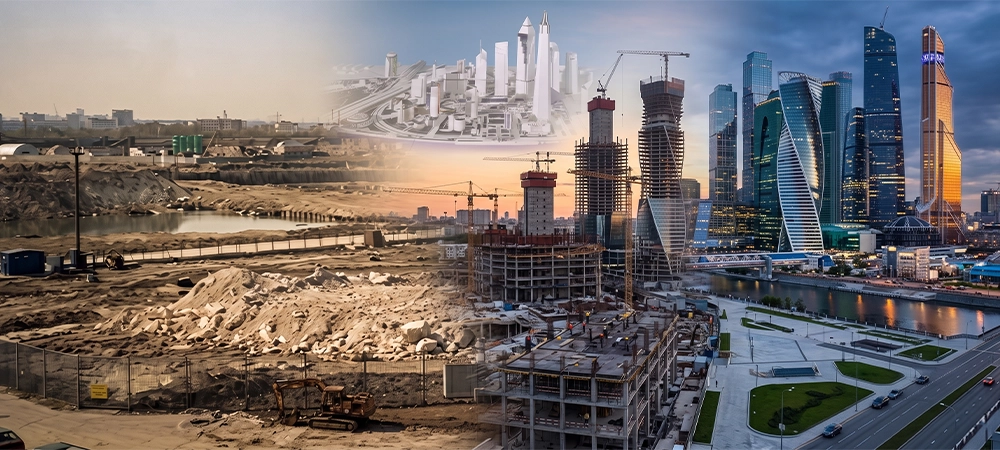
Moscow skyscrapers: all the capital's high-rises, ranking by height, and what is inside

Skyscrapers have long become a new calling card of Moscow, alongside the Kremlin and the Stalinist high-rises. The Moscow City business center, towers soaring above the city, bird's-eye observation decks, the highest offices and restaurants in Europe — all this has turned the capital into one of the main centers of high-rise construction in the world. In this comprehensive guide, we analyze: what skyscrapers exist in Moscow, how tall they are, what is inside, how the city's high-rise panorama has changed, how to get to the observation decks, and which buildings are being constructed right now.
What is a skyscraper: understanding the terminology

Before moving on to the rankings, it is worth defining the concepts. There is no single global standard for the term "skyscraper," but there are generally accepted benchmarks.
High-rise building — a structure with a height of 75 to 100 meters.
Skyscraper — a building taller than 100 meters. It is from this mark that the countdown of real skyscrapers begins in international practice.
Supertall skyscraper — a building taller than 300 meters. There are several of these in Moscow, and all of them are located in Moscow City.
Megatall skyscraper — a building taller than 600 meters. There are none in Russia and Europe yet; the closest object to this category is the Lakhta Center in St. Petersburg (462 meters).
In Moscow, the number of buildings over 100 meters tall already numbers in the dozens, and high-rises from 30 to 95 floors have become unique engineering structures, the creation of which involved world-class architects. Alongside historical monuments, it is the skyscrapers that have become the capital's new attractions.
History of Moscow skyscrapers: from Stalinist high-rises to Moscow City

High-rise construction in Moscow went through two major stages, separated by half a century.
Stalinist high-rises (1947–1957)
Moscow's first true high-rises appeared in the post-war years. According to the country's leadership, the capital was to be adorned with monumental towers setting a new scale for the city. The foundation laying took place in 1947, for Moscow's 850th anniversary. Out of the planned nine buildings, seven were built — they were nicknamed the "Seven Sisters".
The Stalinist high-rises became Moscow's first high-rise dominant feature and defined the city's appearance for decades. They combine monumental architecture in the Stalinist Empire style, pointed spires, and rich decor. Up until the early 2000s, the main building of Moscow State University (MSU) remained the tallest building in Moscow, and until 1990 — the tallest building in Europe.
The Moscow City Era (2000s — present time)
The second and main stage began with the project of the Moscow International Business Center "Moscow City" on the Presnenskaya Embankment. The idea to create a proprietary business district in Moscow, modeled after London's Canary Wharf or Paris's La Défense, was born back in the 1990s, and active construction unfolded in the 2000s.
Moscow City changed the capital's high-rise skyline forever. Supertall skyscrapers have grown here, repeatedly surpassing the Stalinist high-rises, and it is the City today that holds all the height records of Moscow and Europe. While the Stalinist high-rises were built over a decade, the City's towers rose above the city one after another over the course of two decades, and the process continues to this day.
Stalinist high-rises: the Seven Sisters of Moscow
Although by modern standards the Stalinist high-rises are no longer considered supertall, they remain architectural monuments and an important part of the city's high-rise history. Let's consider each of the seven.
| High-rise | Height | Floors | Purpose |
| Main building of MSU | 240 m | 36 | University |
| Hotel Ukraina (Radisson) | 206 m | 34 | Hotel, apartments |
| Residential building on Kotelnicheskaya Embankment | 176 m | 32 | Residential |
| Building of the Russian MFA | 172 m | 27 | Ministry |
| Residential building on Kudrinskaya Square | 156 m | 24 | Residential |
| Building near the Red Gates | 138 m | 24 | Offices, residential |
| Hotel Leningradskaya (Hilton) | 136 m | 21 | Hotel |
Main building of MSU on Sparrow Hills — the tallest and most famous of the Stalinist high-rises. With a spire 240 meters high, it remained the tallest building in Europe for more than half a century. Inside are lecture halls, a museum, and residential sections for students and professors.
Hotel «Ukraina» on Kutuzovsky Prospekt — the second tallest Stalinist high-rise. Today, the Radisson Collection hotel operates here and prestigious apartments are located within.
BUILDING ON KOTELNICHESKAYA EMBANKMENT — one of the most famous residential buildings in Moscow, a symbol of the era. In different years, many famous cultural figures lived here.
MFA BUILDING on Smolenskaya Square — the only high-rise without a star on its spire. The active Ministry of Foreign Affairs of Russia.
BUILDING ON KUDRINSKAYA SQUARE, BUILDING AT THE RED GATES and HOTEL LENINGRADSKAYA (now Hilton Moscow Leningradskaya) complete the seven. Each high-rise became the dominant feature of its district and a model of post-war Moscow architecture.
Moscow City: the heart of high-rise Moscow
The Moscow International Business Center "Moscow City" is the main cluster of skyscrapers in the capital and all of Russia. Almost all of Moscow's supertall buildings are concentrated here, including the tallest in Europe.
Moscow City is located on the Presnenskaya Embankment, in a bend of the Moskva River, a few kilometers from the Kremlin. On a relatively small territory, an ensemble of towers has been erected, combining offices, apartments, hotels, retail galleries, restaurants, and observation decks. The project started in the 1990s on the site of a former industrial quarry zone, and in two decades has turned into one of the most recognizable business districts in Europe.
Key facts about Moscow City:
- The largest business center in Russia and Eastern Europe
- Headquarters of VTB, state corporations, and large businesses are located here
- Three metro stations provide transport accessibility
- The Afimall City shopping center connects the towers into a single space
- Concentration of the tallest buildings in Europe in one point
- Observation decks, restaurants, and bars at record heights
All Moscow City towers: height, floors, and what is inside

Let's consider the main towers of the business center — from the tallest to the lowest, with architectural details and purposes.
Federation Tower Vostok — 374 m
The tallest building in Moscow, Russia, and the second tallest in Europe. 95 above-ground floors, height of 374 meters. The Vostok tower of the Federation complex was designed by architects Sergei Tchoban and Peter Schweger. It combines offices, apartments, the Panorama 360 observation deck on the 89th floor, and top-class infrastructure. At the very top, on the 93rd–95th floors, is the F-375 office penthouse — the highest office in Europe. The tower operates 67 elevators — almost as many as in the main building of MSU.
OKO South Tower — 354 m
The second tallest building in Moscow. 85 floors, height of 354.1 meters. A multifunctional complex with apartments, offices, and an observation deck. On the roof of OKO is one of the most popular open-air observation decks in Moscow City. Next to it is the North Tower of the complex (245 meters, 49 floors).
Mercury City Tower — 339 m
75 floors, height of 339 meters. A recognizable tower of copper-gold color. At the time of its completion, it was the tallest building in Europe. Architects Frank Williams, author of over 20 buildings in Manhattan, and Mikhail Posokhin worked on the project. Combines offices and apartments.
Eurasia — 309 m
70 floors, height of about 309 meters. A multifunctional tower with offices, shops, a fitness center, and apartments.
City of Capitals, "Moscow" Tower — 302 m
76 floors, height of 302 meters. Part of the City of Capitals complex, consisting of two towers — "Moscow" and "St. Petersburg", connected by a common section. Primarily residential and apartment purposes. The building's stability is provided by outrigger floors made of high-strength steel structures.
Naberezhnaya Tower (Tower C) — 268 m
One of the first high-rises in Moscow City. 61 floors, height of 268 meters. Primarily office purposes, headquarters of large companies.
City of Capitals, "St. Petersburg" Tower — 257 m
65 floors, height of 257 meters. The second tower of the City of Capitals complex.
Evolution Tower — 255 m
54 floors, height of 255 meters. A recognizable twisted shape in the form of a spiral — one of the striking architectural landmarks of the City. Office purposes.
OKO North Tower — 245 m
49 floors, height of 244.6 meters. The second tower of the OKO complex, primarily apartments.
Federation Tower West — 243 m
63 floors, height of 243 meters. The second, shorter tower of the Federation complex. The VTB headquarters is located here, occupying more than 50 thousand square meters, as well as apartments, and the highest restaurant in Europe, Sixty, on the 62nd floor.
Imperia — 239 m
60 floors, height of 238.7 meters. A multifunctional complex in the neo-futurism style, designed by the American firm NBBJ. Externally, it resembles an ellipse of glass and steel inscribed in a rectangle. Offices, apartments, hotel.
Ranking: the tallest skyscrapers in Moscow

Consolidated ranking of the capital's tallest buildings as of 2026.
| Rank | Building | Height | Floors | Location |
| 1 | Federation Tower Vostok | 374 m | 95 | Moscow City |
| 2 | OKO South Tower | 354 m | 85 | Moscow City |
| 3 | Mercury City Tower | 339 m | 75 | Moscow City |
| 4 | Eurasia | 309 m | 70 | Moscow City |
| 5 | City of Capitals "Moscow" | 302 m | 76 | Moscow City |
| 6 | Naberezhnaya Tower C | 268 m | 61 | Moscow City |
| 7 | City of Capitals "St. Petersburg" | 257 m | 65 | Moscow City |
| 8 | Evolution Tower | 255 m | 54 | Moscow City |
| 9 | OKO North Tower | 245 m | 49 | Moscow City |
| 10 | Federation Tower West | 243 m | 63 | Moscow City |
As can be seen from the ranking, all ten of Moscow's tallest buildings are located in Moscow City. The Stalinist high-rises, for all their historical significance, have been left far behind in height: the tallest of them, MSU (240 meters), would not even make it into the top ten of the modern ranking.
What is inside Moscow skyscrapers
Modern Moscow skyscrapers are not just office towers. They are multifunctional complexes combining very different functions under one roof.
Offices
The office function remains key for most of the City's towers. Headquarters of the largest Russian companies and corporations are located here. Moscow City offices belong to Class A and Premium, and the highest office in Europe — the F-375 penthouse — is located at the top of the Federation Tower.
Apartments
Many towers include apartments — a premium-class housing format with hotel service. For example, the Federation complex features 191 apartments with a total area of 78 thousand square meters. Apartments on the upper floors cost on average 2.5 times more than on the lower ones, thanks to panoramic views. Housing in Moscow City skyscrapers remains one of the most prestigious real estate formats in the capital.
Observation decks
Moscow City is one of the best cities in the world for a view from above. Main observation decks:
- Panorama 360 on the 89th floor of the Federation Tower — the highest observation deck in Europe
- Observation deck on the roof of OKO — a popular place for photography and watching the sunset
- Panoramic restaurants and bars on the upper floors of the towers
Restaurants and infrastructure
Restaurants with panoramic views are located on the upper floors of the towers. The highest restaurant in Europe — Sixty — is located on the 62nd floor of the Federation Tower West. The towers host fitness centers, pools, spa salons, and conference halls. The Nebo fitness center with a pool in the Federation complex also ranks among the highest in Europe.
How to get to the observation decks of Moscow City
Skyscraper observation decks are one of the main tourist attractions in Moscow. Let's break down how to visit them.
PANORAMA360 in the Federation Tower
The highest observation deck in Europe is located on the 89th floor of the Federation Tower Vostok, at an altitude of 327 meters. Panoramic windows provide a 360-degree circular view.
Address: Presnenskaya Embankment, 12, Federation Tower Vostok. Enter through the south entrance, go down to minus second floor, where the reception and the elevator to the 89th floor are located.
Opening hours: Daily, usually from 10:00–11:00 to 22:00 (last entry around 21:00). The schedule may change on holidays.
Ticket cost: From 1,000 to 2,000 rubles depending on the day and ticket type. Combo tickets with additional activities are available.
What is included: In addition to panoramic views, the deck features an ice cream factory (as a bonus, every visitor receives a cup of ice cream made at an altitude of 327 meters), a chocolate workshop, interactive attractions, a souvenir shop, and the 360 panoramic restaurant. Live music plays in the evenings.
Tip: It is more profitable to buy tickets in advance online on the official website to save time and money.
Observation deck on OKO
An open-air observation deck is equipped on the roof of the OKO tower — one of the few with an open-sky view. A popular spot for shooting sunsets and panoramic photos of Moscow.
How to get to Moscow City
The easiest way to get to the business center is by metro: Delovoy Tsentr (Big Circle Line and MCC), Vystavochnaya and Mezhdunarodnaya (Filyovskaya line) stations. From all stations, there are direct exits to the Afimall City shopping center and to the towers.
Interesting facts about Moscow skyscrapers

High-rise construction is always an engineering challenge. A few curious facts about Moscow skyscrapers:
Elevators. The Federation Tower operates 67 elevators — almost as many as in the main building of MSU. High-speed elevators lift you to the upper floors in a matter of seconds.
Wind resistance. Supertall buildings are designed taking into account severe wind loads. For stability, outrigger floors made of high-strength steel are built into the structures, located every 25–30 floors.
Underground part. Multi-level underground spaces are hidden beneath the City towers: parking lots, retail premises, and technical equipment. For some towers, the underground part goes down 5 floors.
The highest in Europe. Moscow City holds several European records at once: the highest office (F-375), the highest observation deck (Panorama 360), the highest restaurant (Sixty), and one of the highest swimming pools.
High-speed construction. Unlike the Stalinist high-rises, which were built over almost a decade, modern towers are erected in 3–5 years thanks to new technologies and materials.
Moscow skyscrapers outside the City
Although Moscow City concentrates the majority of high-rises, individual skyscrapers are also being built in other districts of the capital.
Residential high-rise complexes up to 75 floors high are being erected in different parts of the city. Notable projects include skyscrapers in the Butyrsky district, residential towers over 270 meters high, and multifunctional complexes with panoramic lounges on the top floors, fitness centers with pools, and art objects on the territory.
Nevertheless, the status of the main and most prestigious high-rise cluster in Moscow remains with Moscow City. An address in the City carries special weight and recognition that pinpoint high-rises in residential areas do not have. This is precisely why the headquarters of the largest companies choose the City, and not individual towers on the outskirts.
The future: what skyscrapers are being built in Moscow now
High-rise construction in Moscow continues to develop. Several dozen buildings up to 85 floors high are currently under construction.
Among the key trends:
- Growth in the number of residential skyscrapers outside the City
- Development of the "Greater City" territory — expansion of the business cluster in the western direction
- Emergence of new supertall projects with a height of 274 meters and above
- Complexes with panoramic lounges on the top floors, fitness, pools, and art objects
- Attention to energy efficiency and "green" technologies
Moscow confidently secures its status as one of the global centers of high-rise construction, and its skyline continues to grow upward. According to forecasts, the number of high-rise complexes in the capital will only increase in the coming years.
Moscow compared to Europe and the world
To appreciate the scale of Moscow's skyscrapers, it is useful to compare them with the global context.
In Europe Moscow is the undisputed leader in high-rise construction. The Federation Tower Vostok (374 m) yields only to the Lakhta Center in St. Petersburg (462 m) in Europe. The tallest buildings in Western Europe — The Shard in London (310 m) and Varso Tower in Warsaw (310 m) — are lower than a whole series of Moscow towers. In fact, the majority of Europe's tallest buildings are located precisely in Russia.
In the world the records belong to the Middle East and Asia: Burj Khalifa in Dubai (828 m), Shanghai Tower (632 m), Abraj Al Bait in Mecca (601 m). Moscow does not claim absolute height world records, but it is among the cities with the most impressive high-rise skylines in Europe.
At the same time, by one indicator, Moscow holds the European leadership unconditionally: the highest office in Europe — the tri-level F-375 penthouse on the 93rd–95th floors of the Federation Tower, at an altitude of 360–370 meters.
The highest office in Europe: F-375 at the top of the Federation Tower
Among all of Moscow's skyscrapers, a special place is occupied by is the F-375 office penthouse — the highest point not only of the Federation Tower but of all office real estate in Europe.
F-375 occupies the top three floors of the Federation Tower Vostok (93rd–95th floors) at an altitude of 360–370 meters. It is a tri-level space of 2,642 square meters under a glass dome 14 meters high. The three levels are connected by panoramic elevators: the employee level, the executive level, and the top management level.
From the height of F-375, a 360-degree circular panorama of all of Moscow opens up: the Kremlin, MSU, Ostankino Tower, the Moskva River, and city blocks to the horizon. This is not just an office on the top floor of a skyscraper, but a unique property with no equivalents in Europe. The property was awarded the Grand Prix at the International Property Awards as the best in the world.
For a company that wants to locate its headquarters at the very top of Moscow's high-rise skyline, F-375 is the absolute maximum possible.
Frequently Asked Questions
Which is the tallest skyscraper in Moscow?
The tallest skyscraper in Moscow is the Federation Tower Vostok in the Moscow City business center. Its height is 374 meters, 95 above-ground floors. It is also the tallest building in Russia after the Lakhta Center in St. Petersburg and the second tallest building in Europe.
How many skyscrapers are in Moscow City?
There are about two dozen high-rise towers located in the Moscow City business center, including all ten of the tallest buildings in Moscow. Among them are the Federation Tower, OKO, Mercury, City of Capitals, Evolution, Imperia, Eurasia, and others.
Where are the tallest buildings in Moscow located?
Practically all of Moscow's tallest buildings are located in the Moscow City business center on the Presnenskaya Embankment, in a bend of the Moskva River. All ten of the capital's tallest buildings are situated exactly here.
What is the highest observation deck in Moscow?
The highest observation deck in Moscow and all of Europe is Panorama 360 on the 89th floor of the Federation Tower in Moscow City, at an altitude of 327 meters. It provides a 360-degree circular view. Also popular is the open-air observation deck on the roof of the OKO tower.
How much does it cost to go up to a Moscow City observation deck?
Tickets to the Panorama360 observation deck on the 89th floor of the Federation Tower cost from 1,000 to 2,000 rubles depending on the day and ticket type. The deck operates daily, and the price includes ice cream made at altitude, and access to interactive zones.
What is taller: the Stalinist high-rises or Moscow City?
Moscow City towers are significantly taller than the Stalinist high-rises. The tallest Stalinist high-rise is the main building of MSU (240 meters), and the tallest City tower is Federation Vostok (374 meters), which is one and a half times taller.
How many Stalinist high-rises are in Moscow?
There are seven Stalinist high-rises in Moscow, they are called the "Seven Sisters": the main building of MSU, Hotel Ukraina, the building on Kotelnicheskaya Embankment, the MFA building, the building on Kudrinskaya Square, the building at the Red Gates, and Hotel Leningradskaya. Originally, nine buildings were planned, but seven were built.
Where is the highest office in Moscow?
The highest office in Moscow and in all of Europe is the F-375 penthouse on the 93rd–95th floors of the Federation Tower Vostok, at an altitude of 360–370 meters. This is a tri-level office penthouse with an area of 2,642 square meters under a glass dome.
What is the tallest building in Russia?
The tallest building in Russia is the Lakhta Center in St. Petersburg with a height of 462 meters. In Moscow, the tallest building is the Federation Tower Vostok (374 meters), which ranks second in Russia and in Europe.
Can you live in Moscow City skyscrapers?
Yes, many Moscow City towers have apartments — a premium housing format with hotel service. For example, the Federation complex includes 191 apartments. Housing on the upper floors costs on average 2.5 times more because of panoramic views.
In brief: Moscow skyscrapers
- Skyscraper — a building taller than 100 meters; supertall — taller than 300 meters
- High-rise history of Moscow: Stalinist high-rises (1947–1957) and Moscow City (2000s — present time)
- There are seven Stalinist high-rises in Moscow, the tallest is MSU (240 m)
- All ten of Moscow's tallest buildings are located in Moscow City
- The tallest skyscraper in Moscow — Federation Tower Vostok (374 m, 95 floors)
- The highest observation deck in Europe — Panorama 360 on the 89th floor of the Federation Tower (327 m)
- Tickets to the observation deck — from 1,000 rubles, open daily
- The highest office in Europe — the F-375 penthouse at the top of the Federation Tower
Do you want an office at the very top of Moscow's high-rise skyline? Learn about the F-375 office penthouse in Federation Tower — Europe’s highest office, located approximately 360 metres above the ground.