Renting a Furnished Office: What Is Included and How to Compare Offers
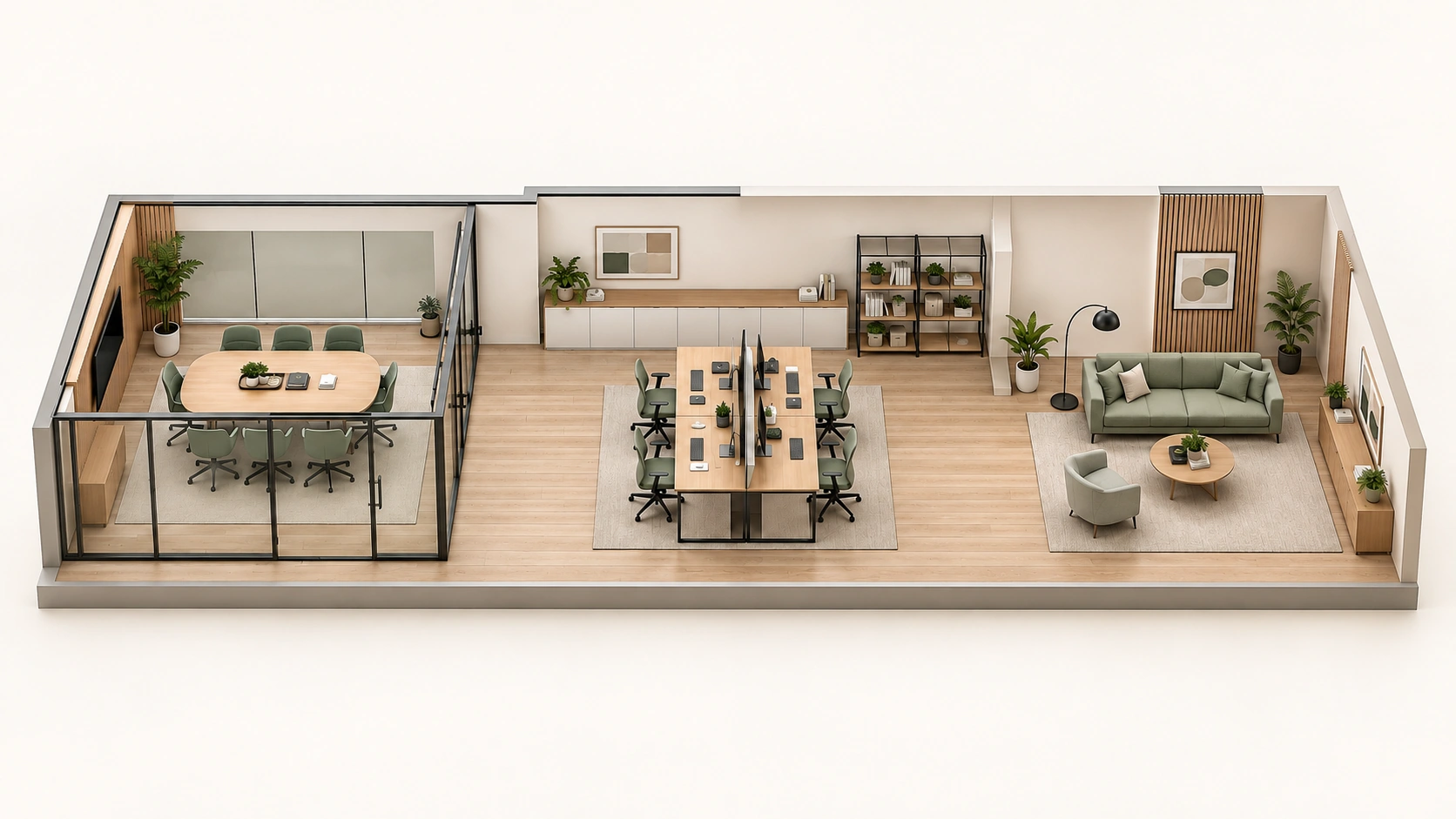
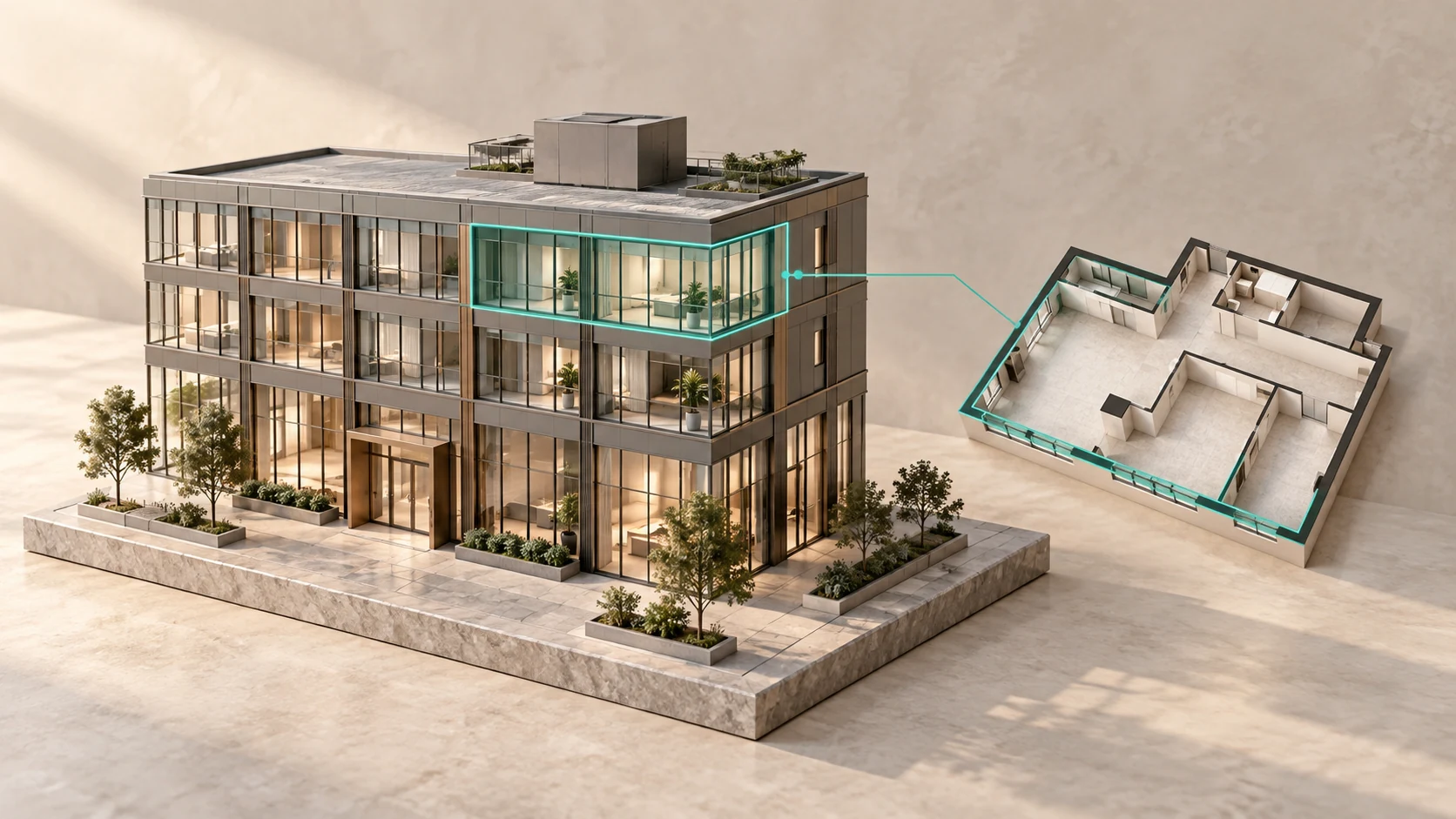
The cover is a conceptual illustration of a furnished office, not a floor plan or photograph of a specific property.
Renting a furnished office means leasing premises where the landlord provides an agreed set of items, such as desks, chairs, cupboards and meeting room furniture. However, the word “furnished” does not mean that computers, internet access, cleaning and everything else needed for work are included in the price. The contents, their condition and the charges must be checked separately.
This option may reduce the amount you need to purchase before moving. Yet savings come not from the furniture shown in the photographs, but from being able to use it without costly replacements or changes to the space. An attractive office with an unsuitable furniture arrangement can require more preparation than an unfurnished space with a suitable layout.
Below is a practical guide to comparing offers for a company looking to rent a furnished office in Moscow: what to request before a viewing, how to assess existing workstations, which costs to compare and what to record when the furniture is handed over.
Furnished, fitted-out and turnkey offices: what is the difference?
These terms describe different features. Fit-out refers to the condition of the premises; furnishing refers to the items provided; and “turnkey” describes the promised level of readiness. They should not be treated as interchangeable, nor should a marketing label be taken as a complete statement of the parties’ obligations.
| Description | What to clarify | What not to assume |
|---|---|---|
| Fitted-out office | The condition of the premises and building systems, and any adaptations required | That the workstations already have furniture |
| Furnished office | The items provided, their quantities and condition, and the terms of use | That equipment and day-to-day services are included in the payment |
| Turnkey office | The scope of work and equipment, readiness criteria and handover date | That work can begin as soon as the lease is signed |
| Serviced Office | The furniture, equipment and service package, including limits and additional charges | That every service is available without limits or extra charges |
A conventional office lease can also include furnished premises. This does not make the space a serviced office: arranging cleaning, connectivity and other services may still be the tenant’s responsibility. For a detailed comparison of the formats, see our article on serviced offices and conventional leases.
A practical way to remove ambiguity is to request a separate list of everything being provided to the company. This should go beyond a general reference to “furniture and equipment” and specify the items, quantities, locations, condition and terms of use. If the contents are still under discussion, distinguish items already available from those promised for later delivery.
Who can benefit from renting a furnished office?
Existing furniture is particularly useful when the team can work with the current configuration. For example, a company may need a self-contained office with workstations, a meeting room and storage, without extensive specialist equipment requirements. In that case, there is no need to select every item from scratch and organise all the deliveries.
For a project team or a new representative office, another consideration matters: the company does not have to buy items whose future use is uncertain. However, an expected short period of occupation does not make every furnished office good value. Check the duration of the commitments, total payments and adaptation costs, not just the initial furniture purchase you could avoid.
If the company already owns furniture, an existing set may be unnecessary. The same applies to teams with specialist workstations, multiple monitors, specific storage requirements or individual seating needs. First decide what you must retain, then establish whether the landlord’s items can be removed or replaced.
A useful selection criterion is this: how many existing workstations can you use without changes? If a substantial share of the desks must be moved, chairs replaced and cupboards taken away, assess the offer as a partially furnished office. In that situation, the supposed benefit of having “everything already in place” needs to be recalculated.
What to request before a viewing: an inventory, photographs and a plan
Before travelling, ask for current photographs of the actual office being offered and a furniture layout plan. Find out when the photographs were taken and which items will remain at handover. The pictures may show belongings of the current tenant that are not included, or equipment available only under a separate agreement.
A short specification organised by area is enough for an initial shortlist. It allows you to compare several premises on the same basis and identify missing items in advance. It is better to hear “not included” before a viewing than to build a budget on the assumption that an item in a photograph will automatically come with the office.
- Workstations: the number of desks and chairs, desktop dimensions, adjustment options, pedestals, desk screens and access to power.
- Meeting rooms: tables, seating, displays, video conferencing and boards; whether the room is dedicated or shared and bookable.
- Storage: cupboards, archive storage, locks and keys; whether there is room for your team’s documents.
- Reception and visitor areas: the reception desk, chairs and coat storage; which facilities are dedicated to the company and which are shared.
- Kitchen and other facilities: furniture listed separately from the fridge, dishwasher and other appliances.
- IT equipment: which parts of the network infrastructure remain and who is responsible for connection and maintenance.
Do not combine furniture and technology into a single line labelled “equipped office”. A desk does not establish that a monitor is included, and a display installed in a meeting room does not establish that video conferencing will work with your corporate systems. Unclear items need separate answers and checks.
How to check workstations during a viewing
Count usable workstations, not chairs
Check where employees will sit, taking their actual tasks into account. Is there enough room for the monitors and documents they need? Can pedestals be opened while someone is sitting at the desk? Can a chair be moved back without blocking a passage? Is the seating comfortable for extended work? Check these points in a normal working position, not just from an overall photograph of the room.
Seats at a meeting table should not automatically be counted as permanent workstations. If employees occupy the meeting room every day, it no longer serves its original purpose. Similarly, a sofa in the waiting area does not make up for a shortage of proper workstations for the team.
Consider a hypothetical example: a listing advertises 24 seats, but eight of them are in the meeting room. That is not the same as 24 permanent workstations plus a separate meeting room. This example does not establish a space standard; it shows why the types of seats matter more than the headline number in the listing.
Check the condition and suitability of the furniture
For desks, inspect stability, fixings, surfaces and cable access points. For chairs, test the adjustments, castors, armrests and backrest locking mechanism. For cupboards, check doors, shelves, locks and keys. Record visible defects and separately discuss items that cannot be used properly.
It is useful for a team representative to bring their usual work equipment or its dimensions: a laptop, monitor requirements, docking stations and peripherals. A desk that looks tidy may still have unsuitable depth or support positions. The furniture arrangement also needs to work as a whole: moving one row may require changes to cables, sockets or lighting arrangements.
Do not attempt to assess electrical safety or building systems yourself. If there are concerns about electrical loads, wiring or whether equipment can be installed, request confirmation from the building management company and relevant specialists. Inspecting furniture does not replace a technical assessment of the premises.
Assess the configuration against your team’s needs
Mark the areas for focused work, calls, meetings, storage and visitor circulation on the plan. Existing furniture should not force the company to change its working practices simply because the arrangement suited the previous tenant. Pay particular attention to meeting rooms, enclosed offices and visitors’ routes through the working area.
Clarify whether furniture can be rearranged before deciding to rent. Some items may be built in, and moving them may affect finishes and building systems. If you need a different configuration, compare the types of office layouts. Then seek approval for the specific changes, their costs and who will carry them out.
How to compare the cost of furnished and unfurnished offices
Compare premises that meet equivalent needs for the team: workstations, meeting rooms and storage. A cheap office that does not accommodate the team properly is not good value simply because its rent is low. The opposite mistake is paying for a large furniture package when much of it is not needed.
Prepare a budget for both options over the same planned period. If payments change, apply them to the relevant months. Establish whether the furniture charge is included in the office rent, charged separately or covered by another document. Paying to use furniture does not mean that ownership will eventually pass to the tenant.
| Cost category | Furnished office | Unfurnished office |
|---|---|---|
| Preparation | Additional items, replacement of unsuitable furniture and rearrangement | Furniture purchase or rental, delivery, assembly and positioning |
| Recurring payments | Office rent and any separate charge for furniture | Office rent and maintenance of the company’s own furnishings |
| Changes during occupation | Agreed replacements, additional workstations and repairs under the agreed terms | Additional purchases, repairs and arranging furniture moves |
| End of the lease | Return of the furniture and agreed reinstatement work | Removal, storage or sale of the company’s own furniture |
A simplified calculation adds initial non-refundable costs, total recurring payments over the chosen period, one-off costs during occupation and expected costs at the end of the lease. For furniture you own, a cautious estimate of sale proceeds can be considered separately if that is a realistic option. Do not treat a future sale at the original purchase price as a guaranteed outcome.
Show refundable security payments separately as funds needed at the outset. Do not count the entire amount as an expense, but do not overlook it when assessing the funding required. Potential deductions, financing costs and tax implications need separate assessment against the terms of the particular transaction.
Check that the same services have not been counted twice and that the tax treatment of the offers is comparable. Cleaning, connectivity, utilities and operating charges can materially affect the comparison, but they do not automatically follow from the word “furnished”. For more detail, see our article on office operating costs.
There is no universal premium for furniture or fixed period after which buying it is necessarily better value. The answer depends on the items provided, how long they will be used, the changes required and the specific commercial terms. Ask for a calculation for the offices you are considering, rather than relying on an unverified average percentage.
Furniture inventory: how to record contents and condition
Before the office is handed over, agree on a document that gives both parties the same understanding of the items provided. The phrase “furniture in satisfactory condition” is of little help if disagreements later arise about quantities, existing damage or missing components.
A practical inventory can include the item name, quantity, model or another identifiable description, location and condition. Add identifiers for equipment where available, and a list of keys for lockable items. Numbered entries make it easier to link records to photographs without confusing similar desks and chairs.
Photograph not only close-ups of defects but also the whole item in its location. For example, “chair by the window in the private office, backrest does not lock, photo 12” is more informative than “some defects”. Photographs should be linked to the agreed documents and available to both parties, rather than kept only on an employee’s phone.
If the landlord promises to replace a faulty item, record exactly which item, what will replace it, who is responsible for delivery and how completion will be confirmed. Distinguish the items actually handed over from future deliveries. Also clarify the landlord’s right to provide the furniture: the previous tenant’s belongings cannot be treated as part of the offer without confirmation.
It is best to agree in advance how condition will be recorded, damage assessed, repairs arranged and payments settled on return, taking the particular lease into account. This is a practical list of questions, not a universal legal template. For a broader review of the transaction terms, see our article on office lease agreements.
Can you replace the furniture and bring your own?
This needs to be discussed before signing the documents. Permission to use the premises does not, by itself, answer where the landlord’s cupboards can be moved, who pays for storage or whether the original arrangement must be restored. Even an apparently small replacement can affect preparation costs and the arrangements for returning the office.
Agree what will happen to every unwanted item: whether the landlord will collect it, it will be stored in a designated area or it will be removed under a separate arrangement. Clarify who will do the work, the costs and responsibility during the move. Do not discard or sell items that do not belong to you.
For furniture you buy, separately establish whether it remains the company’s property and whether it can be removed at the end of the lease. Built-in solutions and changes to finishes require a more detailed review of the terms. If the plans go beyond rearranging furniture and involve alterations to the space, assess the scope of the office fit-out. Do not bury this work under “minor adaptations”.
When is a furnished office genuinely ready to move into?
Distinguish three events: viewing the premises, taking handover of the furniture and being able to work normally. There may still be defects to remedy, an existing occupier to move out, connectivity to set up, access to arrange and missing items to deliver. There is therefore no single move-in timeline for every furnished office.
Request a list of readiness requirements specific to your company. It should state which items must be in place, which defects will be remedied, what will be checked jointly and who will confirm completion. Check the payment start date and the consequences of delay against the documents, rather than inferring them from a promise that “the office is ready”.
For an office in Moscow City, also clarify the rules for bringing furniture in and taking it out: booking requirements, permitted hours, delivery vehicle access, lift use and contractor work. These conditions depend on the building and the particular premises. Existing furniture may reduce the number of deliveries, but it does not remove the need to check building procedures and access for your team.
Once you have chosen the premises, move on to organising the office relocation. The task here is different: to make sure the promised furniture and equipment actually match the chosen option and are included in the budget before commitments are made.
A checklist for comparing offers
Request answers to these questions in a consistent format. It is better to leave an unanswered point open than to replace it with an assumption. This reveals which offers are ready for a detailed discussion and which need further clarification.
- Do all photographs show the actual office being offered and the furniture that will remain?
- How many permanent workstations can the team use without replacing furniture?
- Are there separate meeting rooms and enough storage?
- Which items, equipment and services are not included?
- Which defects have been identified, and who will remedy them before handover?
- Can the furniture be rearranged, unwanted items removed and your own items added?
- What one-off and recurring costs arise in addition to the office rent?
- How are the contents, condition, repairs and return of the furniture documented?
- What must be completed by the agreed readiness date?
- How do the options compare over the same period, including the end of the lease?
If you are considering an office in Federation Tower, contact the F-375 team. Provide your team size, the working areas you need, the furniture you already have, your preferred move-in date and your budget. This will help focus the discussion on whether the property meets your requirements. The availability of suitable premises, their contents and the terms are confirmed individually.
Frequently Asked Questions
What is included when renting a furnished office?
Only the agreed set of items. This may include desks, chairs, cupboards and meeting room furniture, but there is no single mandatory package for every offer. Ask for an inventory and separately clarify equipment, internet access, cleaning and additional payments.
Is a furnished office the same as a serviced office?
Not necessarily. Furnishing describes the items provided in the premises, while a serviced office includes an agreed service package. A conventional office can also be let with furniture, while the tenant arranges connectivity, cleaning and other services separately.
Is it better value to rent a furnished office or buy your own furniture?
Compare total costs over the same period: preparation, recurring payments, replacements and costs when moving out. Existing furniture is useful if it suits the team without substantial alterations. There is no universal savings percentage or period after which buying is always better value.
Do you need an inventory if the furniture is already shown in photographs?
To establish clearly what is included, photographs are best linked to a list of the items and their condition. The inventory records items, quantities, identifiable descriptions, defects and completeness. Photographs support this information but do not, on their own, explain all the handover and return terms.
Can you move in as soon as the lease is signed?
Only if the handover and readiness requirements for your company have been met. Check that the premises are vacant, the agreed items are in place, defects have been remedied, and connectivity and access are arranged. The presence of furniture alone does not establish that all these matters have been resolved.