Office Rent-Free Periods: Timing, Payments and Savings
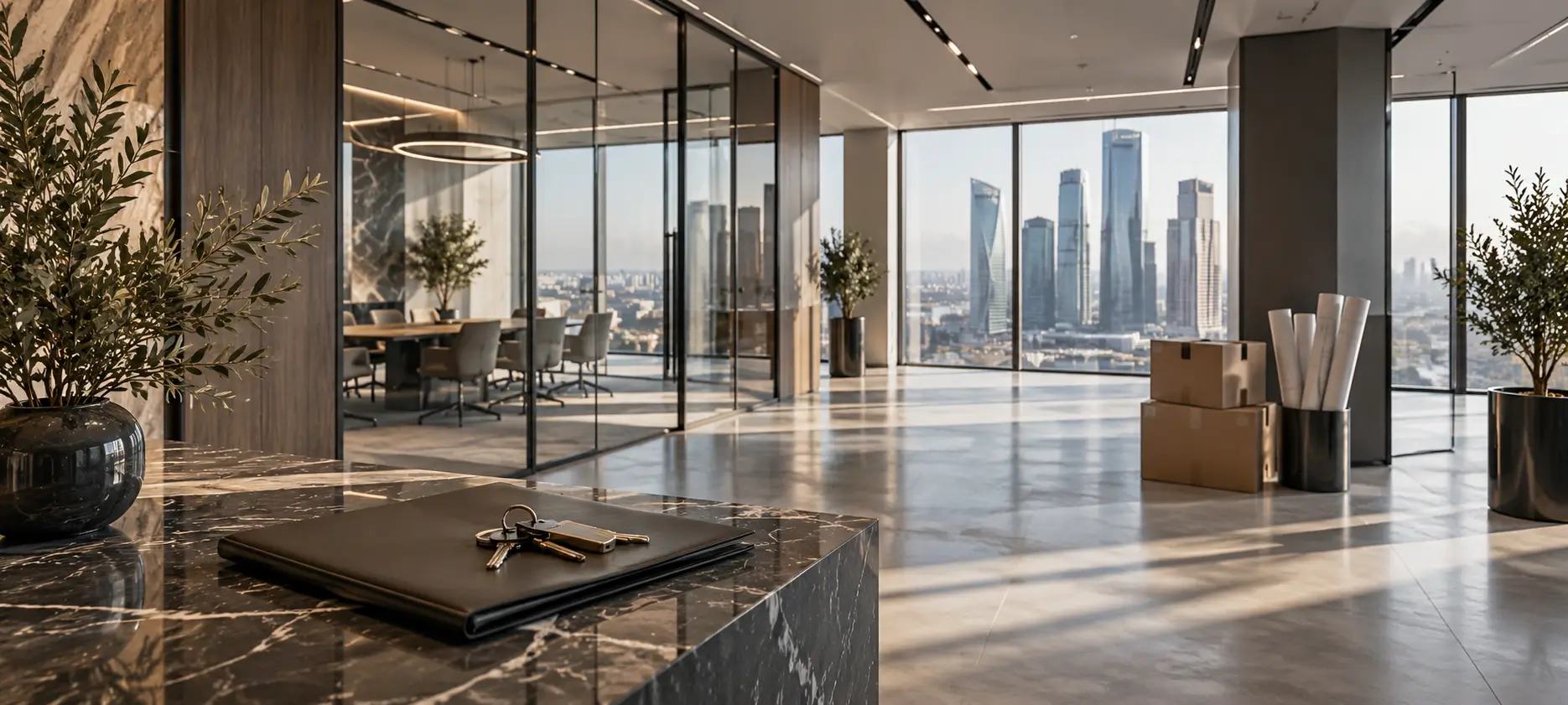
A rent-free period in an office lease is an agreed period during which the landlord reduces or waives the base rent. This helps a business prepare the premises, carry out fit-out works and organise its move. The precise arrangement and payment schedule must be recorded in the lease.
However, a rent-free period does not make running the office free of charge. Service charges, utilities, parking and the security deposit may still be payable. Assess an offer of “two months rent-free” against three criteria: which amounts are waived, when the concession starts and how much the business will pay over the full lease term.
How does a rent-free period differ from deferred payment?
During negotiations, the same term is sometimes used for different arrangements. The distinction matters to the company’s budget.
| Terms | What happens to payments | Does it create a saving? |
|---|---|---|
| Temporary rent reduction | A lower rent is charged for an agreed period | Yes, by the amount of the discount |
| Base rent waiver | No base rent is charged for the agreed period | Yes, but other charges may still apply |
| Deferred payment | Rent already charged may be paid later | The rent amount itself is not reduced |
| Payment by instalments | The payment is divided into parts | The rent amount itself is not reduced |
| Agreed fit-out costs offset against rent | The cost of works accepted by the landlord is credited towards payments | Depends on the cost of the works and the offset terms |
If the landlord offers no payments for the first two months, clarify whether those amounts are waived or added to later invoices. The latter is deferred payment. It may ease the move, but it does not reduce the overall rental cost.
The lease determines the procedure, terms and deadlines for rent payments. A verbal agreement therefore needs to be translated into specific amounts and dates. The legal basis is Article 614 of the Russian Civil Code.
When can a rent-free period be negotiated, and for how long?
For a new office lease, the time needed to prepare the premises is a strong negotiating point. A company can support its request with details of finishing works, equipment installation, connectivity and relocating workstations.
A fitted office may need only a short settling-in period. Shell-and-core space requires design and construction work, so negotiations may involve several months. The distinction between a short moving-in concession and a longer fit-out period is noted, for example, by IPG.Estate.
There is no universal rent-free period for an office of a given size. Support the request with a programme of works:
- Measured surveys, the design brief and design work.
- Design approvals and contractor access arrangements.
- Delivery of materials and equipment.
- Construction and installation works.
- Systems testing, furniture installation and the move.
Some stages may run in parallel. It makes sense to negotiate the rent-free period around the realistic date when the office will be ready, rather than simply adding up every duration in the estimate. The scope of work is explained in detail in the article on office fit-out.
In a standard commercial transaction, the parties agree the concession: the need for fit-out work does not itself entitle the tenant to stop paying under the current schedule. The general principle of freedom of contract is set out in Article 421 of the Russian Civil Code.
For negotiations, prepare not only your preferred period but also a case for the landlord: the intended lease term, the budget for agreed improvements and a clear schedule for moving to full rent. A long lease may form part of the offer, but its obligations should be assessed in advance.
Which charges still apply during a rent-free period?
Before signing the lease, request separate payment calculations for the concession period and a normal rental month.
| Payment category | What to clarify |
|---|---|
| Base rent | Whether it is reduced in full or in part, and whether any rent accrues for later payment |
| Operating expenses — OPEX | Whether they apply from the handover date, and at what amount |
| Utilities | How actual consumption and fixed charges are accounted for |
| Parking and additional services | Whether they are included in the concession or paid separately |
| Security deposit | When it is paid, which rent is used to calculate it and when it is refunded |
| Fit-out arrangements | Whether waste disposal, access and construction logistics attract separate charges |
Also check how VAT is presented in each offer: included in the amount, added separately or not charged. Compare offers on the same tax basis.
Treat the security deposit separately. Even if it is refundable, the company needs cash to pay it. Lower rental expenses therefore do not necessarily mean an equivalent reduction in the upfront budget.
The components of recurring costs and calculation methods are explained in the article on office operating costs.
How to calculate the benefit: a 300 m² office example
Consider an illustrative offer. All amounts below exclude VAT, with no indexation. This demonstrates the method rather than current market rates.
| Parameter | Terms |
|---|---|
| Office Size | 300 sq m |
| Base rent | ₽60,000/m² per year |
| Monthly base rent | 1 500 000 ₽ |
| Rent-free period | No base rent charged for the first 2 full months |
| Service charges | ₽10,000/m² per year, payable for all 12 months |
| Utilities | Assumed at ₽50,000 per month for all 12 months |
Without the rent-free period, annual base rent would be:
300 × 60,000 = ₽18,000,000.
With two rent-free months:
1,500,000 × 10 = ₽15,000,000.
The saving on base rent in the first year is 3 000 000 ₽. Service charges add ₽3,000,000, and utilities ₽600,000.
The total payable across these three categories is:
15,000,000 + 3,000,000 + 600,000 = ₽18,600,000 for the first year.
Even during the rent-free period, monthly payments in this example total ₽300,000: ₽250,000 in service charges and ₽50,000 for utilities. Fit-out, furniture, parking and the security deposit are not included.
The effective base rent is useful for comparing offers:
Effective annual base rent per m² = base rent actually charged over 12 months ÷ floor area.
In our example, this is 15,000,000 ÷ 300 = ₽50,000/m² per year. Including the assumed service charges and utility costs gives ₽62,000/m² per year. These measures answer different questions: the first describes rent, while the second is the total of the three cost categories included.
Which is better: two rent-free months or a 6% discount?
Compare the same office over three years. Assume all other terms are identical, there is no indexation and the discount applies for all 36 months.
| Option | Base rent for the first year | Base rent over 3 years |
|---|---|---|
| 2 rent-free months, then ₽1,500,000 per month | 15 000 000 ₽ | 51 000 000 ₽ |
| 6% discount with no rent-free period: ₽1,410,000 per month | 16 920 000 ₽ | 50 760 000 ₽ |
The rent-free period reduces first-year payments more. In this example, the ongoing discount produces a lower total over three years, by ₽240,000.
With a constant rent, two free months over a 36-month lease are equivalent to:
2 ÷ 36 × 100% ≈ 5.56%.
This compares nominal amounts. It does not account for the time value of money: for a company financing its move with a loan, earlier savings may have additional value. Indexation, partial discounts or different payment dates require a month-by-month calculation.
When does the rent-free period start?
The dates of signing the lease, handing over the premises and obtaining actual access for fit-out may differ. If the rent-free period has started but the contractor cannot begin work, some of the agreed benefit is lost.
Before signing, agree:
- the event that starts the concession period;
- the condition of the premises at handover;
- arrangements for contractor access and material deliveries;
- the date when service charges become payable;
- the procedure for delays caused by the landlord or managing agent;
- the date when full rent begins.
For example, the parties could agree that the period starts when the handover report is signed, with the premises in the agreed condition and access available for the works. Appropriate wording depends on the property and the lease.
For an office in a skyscraper, request the fit-out rules in advance: permitted hours for noisy work, goods lift booking procedures, approvals for building services designs and equipment connections. When choosing an office to rent in Federation Tower , include these issues in discussions alongside rent, floor level and layout.
It is also best to agree in advance whether the rent-free period can be extended if fit-out is delayed. A contractor’s delay does not itself alter the contractual rent payment schedule.
How to record the terms in the lease
Set out the agreement in a separate lease section or an addendum, and check that it does not conflict with the main payment schedule.
An eight-point checklist is useful:
- Premises. Which office or part of the space being handed over the terms apply to.
- Purpose. Why the concession period is granted: preparation, fit-out or relocation.
- Duration. The dates, or an unambiguous starting event and method for counting the period.
- Amounts. Base rent during and after the concession, and how a partial month is calculated.
- Other payments. Service charges, utilities, VAT, parking and the deposit.
- Works. The agreed alterations and responsibility for approvals and acceptance.
- Delays. The circumstances in which the period changes and the documents required to record this.
- Early exit. Whether the discount must be repaid if the lease ends early and how the amount is calculated.
The final point affects the economics of the deal. If a landlord grants a rent-free period in anticipation of a long lease, the contract may require the discount to be repaid on early exit. Before signing, model a move after one year: this payment may be added to the costs of the new office.
If the concession is linked to fit-out works
Agree which works the tenant will carry out, who will accept the completed works and whether costs will be reimbursed. If fit-out costs are offset against rent, the amount, documents and offset procedure must be clear.
Improvements that cannot be removed without damage require particular attention. As a general rule, the right to reimbursement for improvements made at the tenant’s expense with the landlord’s consent depends, among other things, on the lease terms; a different rule applies to work carried out without consent. A promise that “we will reimburse the investment later” must therefore be made specific before work begins. The legal basis is Article 623 of the Russian Civil Code.
A full rent waiver and the offsetting of fit-out costs also require assessment of the tax implications. In particular, there is a risk that the period could be treated as gratuitous use. This depends on the structure of the transaction; the label “rent-free period” alone does not resolve the issue. These risks are discussed in a ConsultantPlus compilation. The final wording should be agreed with the parties’ lawyers and accountants.
What should landlords and buyers of tenanted offices check?
For the landlord, a concession period changes cash receipts. Compare options allowing for potential vacancy, tenant-finding costs and the amount of agreed investment in the premises.
In the financial model, separate the first year with its concession from the subsequent period of full rent. The method is explained in “How to Calculate Office Investment Returns”.
When buying a tenanted office , check the main lease and all addenda for any outstanding rent-free months, temporary discounts or agreed reimbursement of fit-out costs. Compare the rent quoted in the presentation with the actual schedule of receipts.
If your company is considering its own headquarters in Moscow City, explore layouts and discuss purchase terms on the page for the F‑375 office penthouse.
Frequently Asked Questions
Does a rent-free period mean the office is completely free?
No. It may apply only to base rent. Service charges, utilities and other payments remain payable unless the parties agree otherwise.
Must the landlord grant a rent-free period for fit-out?
In a standard commercial transaction, this is agreed between the parties. The need for fit-out does not itself permit the tenant to stop paying under an existing lease.
How long can a rent-free period last?
The duration is agreed individually, taking account of the office condition, the preparation required and the lease terms. A programme of works and relocation provides a useful basis.
How does a rent-free period differ from deferred payment?
During a rent-free period, the agreed rent is reduced or not charged. With deferred payment, the amount charged must be paid later.
Is the rent-free period extended if fit-out is delayed?
Any extension must follow the lease terms or a new agreement between the parties. A contractor’s delay does not itself change the payment schedule.
Which is better: a rent-free period or an ongoing discount?
This depends on the lease term and payment schedule. A rent-free period reduces the initial burden, while an ongoing discount may produce greater savings over several years. Compare the full period being considered.

