Office Lease Security Deposit: Amount, Refunds and Lease Terms
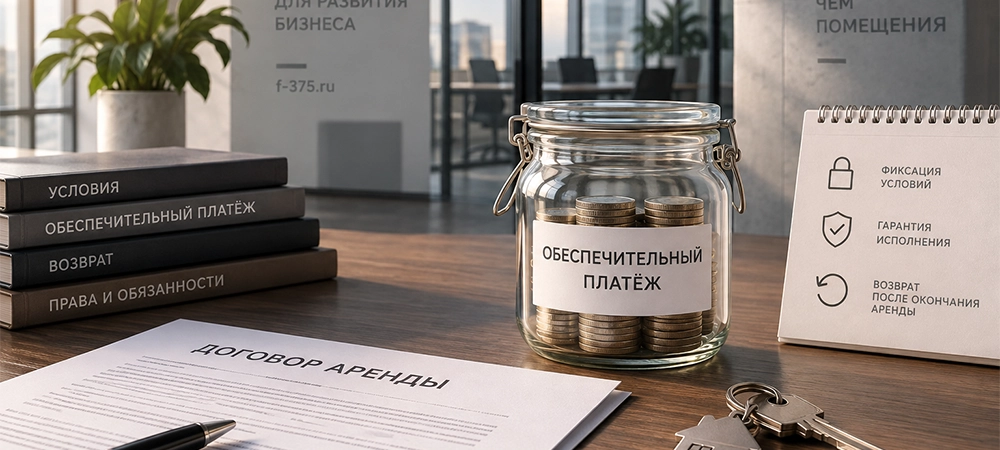
An office lease security deposit is a sum paid by the tenant to the landlord to secure financial obligations under the lease. For example, it may be applied towards rent arrears or a claim for damages if the agreement provides for this.
For a business, this is a substantial part of the relocation budget: the money must be paid upfront, even though the landlord may hold it for several years. A security deposit does not automatically become payment for the final month, and the word “refundable” in an offer does not explain the conditions for repayment.
Before signing the lease, clarify four points: how the amount is calculated, which obligations it secures, when it may be used and when the remaining balance will be refunded.
What is a security deposit and why is it needed?
This mechanism is provided for in Article 381.1 of the Russian Civil Code. The parties may secure financial obligations, including future obligations, by paying a specified sum. When the agreed circumstances arise, the money is applied towards the relevant obligation.
For office premises, the lease may provide security for:
- rent payments;
- service charges and utility bills;
- compensation for damage to the premises or property;
- contractual penalties;
- other expressly specified financial obligations of the tenant.
For the landlord, this reduces the risk of non-payment. For the tenant, it affects cash requirements and must be clear before any money is transferred.
The deposit should not be regarded as an automatic cap on liability either. Whether the tenant’s liability is limited to any particular amount must be checked separately against the lease terms and applicable rules.
Security deposits, advance payments and earnest money: what is the difference?
Listings use terms such as “security deposit”, “office deposit” and “guarantee payment”. The name alone does not establish how the money will be used. Read the relevant section of the lease.
| Term | Primary use | What to check |
|---|---|---|
| Security deposit | Secures agreed financial obligations | Grounds for use, topping up and refund |
| Advance payment | Pays future rent or another charge in advance | Which period it covers and when it will be applied |
| Earnest money (zadatok) | Counts towards payments, confirms that the agreement has been concluded and secures its performance | The written agreement and consequences of non-performance |
| “Security deposit” | In practice, this term may refer to a security payment | The legal arrangement the parties have set out in the lease |
Earnest money is regulated separately: in certain circumstances, the recipient keeps it or returns twice the amount. These consequences do not automatically apply to a security deposit. The rules are set out in Articles 380 and 381 of the Russian Civil Code.
In the bank transfer reference, it is useful to give the payment’s exact name, the lease number and the clause under which the money is being paid. This reduces the likelihood of a dispute over whether the sum was security or an advance payment.
How is the security deposit amount determined?
Article 381.1 of the Russian Civil Code does not prescribe a mandatory deposit of one, two or three months for a standard commercial office lease. The parties agree the amount.
It may be a fixed sum or calculated using a formula:
Security deposit = agreed monthly calculation base × number of months covered.
The key is to define the calculation base. “Two months’ rent” may mean two different calculations: base rent alone, or rent plus service charges. For a large office, the difference can be substantial.
Clarify the following in the commercial offer:
- Whether service charges are included in the calculation.
- How VAT is treated and whether any additional payment is required on top of the stated amount.
- Whether the full rent or a discounted introductory rate is used.
- When the money must be received: after the lease is signed, before the office is handed over, or according to a separate schedule.
- Whether the deposit changes when the rent is indexed.
When comparing offers for office space to rent in Federation Tower ask for the total amount payable upfront. The rate per square metre alone does not show the size of the initial payment.
Can the deposit increase during the lease?
The lease may provide for additional payments or a partial refund of the deposit in certain circumstances. This is permitted under paragraph 3 of Article 381.1 of the Russian Civil Code.
For example, if the amount is linked to two current monthly payments, a top-up may be required after indexation. If the deposit has been used to settle arrears, the lease may also require it to be replenished.
Check not only the grounds for a top-up, but also the deadline, notification procedure and documents supporting the calculation. If the deposit is a fixed sum, do not simply assume it automatically changes with the rent.
How much cash is needed to move in? A worked example
Suppose a company rents a 200 m² office. All amounts are illustrative, exclude VAT and are used to explain the calculation; they are neither market rates nor a final invoice for a specific property.
| Metric | Terms |
|---|---|
| Base rent | ₽48,000/m² per year |
| Monthly base rent | 800 000 ₽ |
| Monthly service charges | 150 000 ₽ |
| Deposit basis | Two months’ base rent |
| Security deposit | 1 600 000 ₽ |
Monthly rent is calculated as follows:
200 × 48,000 ÷ 12 = ₽800,000.
If the deposit, rent and service charges for the first month must be paid before moving in, the amount required is:
1 600 000 + 800 000 + 150 000 = 2 550 000 ₽.
Utilities, parking, fit-out, furniture and moving costs are not included. Add these as separate items. Recurring charges are explained in the article on office operating costs.
Now change just one condition: the deposit is calculated on base rent plus service charges. It then amounts to:
(800,000 + 150,000) × 2 = ₽1,900,000.
The upfront amount increases to 2 850 000 ₽. The ₽300,000 difference arises from the definition of the calculation base, even though the floor area and rental rate remain the same.
In a cash-flow budget, it is useful to show the refundable deposit separately from ongoing rental expenses. Cash is needed upfront, but if the deposit is later refunded, the same amount should not also be counted as money spent. Tax and accounting treatment are determined separately.
Is the deposit payable during a rent-free period?
The concession on base rent and the deadline for paying the deposit are separate terms. Even if the landlord has agreed to a month without base rent, the lease may require the deposit to be paid before the keys are handed over.
In our example, if base rent is waived for the first month but service charges and the original deposit payment date remain unchanged, the amount required is:
1 600 000 + 150 000 = 1 750 000 ₽.
Therefore, rent-free periods for an office lease should be assessed alongside the security deposit and other upfront costs. Paying the deposit in instalments can be discussed during negotiations, but the agreed schedule must be recorded in the lease.
Can the security deposit pay for the final month?
This is possible if the lease or a separate agreement between the parties provides for it. Do not simply skip a payment on the grounds that “the landlord already has the deposit”: this may create arrears.
If the deposit is to be applied towards payments, agree in advance:
- which period it covers;
- how much of the deposit will be used;
- whether it is applied only to base rent or to other charges as well;
- whether notice is required;
- how a partial month and the remaining refund are calculated.
It is useful to prepare a final settlement statement in advance: charges for the last period, amounts paid separately, amounts covered by the deposit and the balance to be refunded. The same sum must not be shown as both refundable and applied towards payment.
When can the landlord retain money?
To check a deduction, compare three things: the obligation secured, the basis of the claim and the amount calculated. For example, rent arrears are checked against the schedule of charges and payments, while a claim for damage is checked against the condition of the office, the lease terms and supporting documents.
“We will refund it minus repairs” is too vague to ensure a smooth end to the lease. Agree in advance how defects will be recorded, who will assess the works, and how the tenant will receive the calculation and be able to object.
Damage and fair wear and tear
Under Article 622 of the Russian Civil Code, the premises must be returned in the condition in which they were received, allowing for fair wear and tear, or in the condition specified in the lease. Read any reinstatement requirements before moving in. Article 622 of the Russian Civil Code.
A detailed handover report with photographs is a practical safeguard against disputes. Record the condition of floors, walls, doors, glass partitions, building services equipment and any furniture supplied with the office.
If the company carries out an office fit-out, agree separately what will happen to partitions, cable routes, built-in furniture and other alterations. An obligation to remove them and reinstate the finishes can significantly affect move-out costs.
Ending the lease early
It cannot be assumed that the deposit is always refunded or always forfeited on an early exit. Check the termination provisions, notice period, any break fee, penalties for breach and rules for using the deposit.
A separate fee for an agreed early exit and a penalty for breach have different grounds. Disputed clauses providing for the entire deposit to be retained should be reviewed with a lawyer in the context of the specific lease and the circumstances in which it ends.
How to recover the security deposit
As a general rule, the deposit is refunded if the circumstances specified in the lease do not arise within the agreed period or the secured obligation ends. The parties may agree otherwise. The basis is paragraph 2 of Article 381.1 of the Russian Civil Code.
To complete the settlement without protracted correspondence:
- Check the termination procedure and send the required notices.
- Agree a date for inspecting and handing back the premises.
- Record the office condition, meter readings and return of the keys.
- Reconcile charges and payments, and request a breakdown of proposed deductions.
- Confirm the refund amount, bank details and payment date.
- If the deadline is missed, send a written demand through the channel specified in the lease and retain proof of sending.
The lease should specify a clear refund deadline and the event from which it runs. For example, the parties may agree a set number of working days after the premises are handed back and the stipulated settlements are completed. This is a contractual term, not a universal deadline for every office.
If utility bills arrive later, the parties can agree in advance to refund most of the deposit while temporarily retaining a reserve for those charges. The reserve needs a maximum amount, a list of covered costs and a final settlement date.
An example of a final settlement
Suppose the landlord still holds ₽1,600,000. The parties have confirmed the following claims, which are to be settled from the deposit under the lease:
| Item | Amount |
|---|---|
| Outstanding rent | 100 000 ₽ |
| Utility charges | 20 000 ₽ |
| Agreed compensation for damage | 80 000 ₽ |
| Total deductions | 200 000 ₽ |
| Balance to be refunded | 1 400 000 ₽ |
The calculation is meaningful only if the grounds and amounts are substantiated. Holding a deposit does not remove the need to justify the claims made.
What should an investor check when buying a tenanted office?
When buying a tenanted office treat the security deposit as a separate due diligence item. Request the lease, proof of payment, details of any amounts already applied and the current balance.
The transaction documents must specify how this sum is treated in the settlement between seller and buyer and who will fulfil the corresponding obligations to the tenant. A presentation stating only “deposit: two months” is not enough. A refundable deposit should not automatically be included in the property’s sustainable rental income.
If a company is comparing leasing with buying its own headquarters, it should consider the deposit, preparation of the premises and future move-out conditions alongside monthly payments. The layout and specifications of a distinctive executive space can be explored on the page for the F‑375 office penthouse.
Frequently Asked Questions
Is a security deposit mandatory when renting an office?
For a standard commercial office lease, the parties agree whether a deposit is required and its amount. If the signed lease includes this requirement, payment must be made in accordance with its terms.
Is the security deposit always equal to one month’s rent?
No. The parties may agree a fixed sum or a calculation formula. Clarify the number of months, the components of the calculation base and how the amount may change.
Can the deposit be applied to the final month?
Yes, if the lease or a separate agreement between the parties provides for it. Do not stop making scheduled payments simply because a deposit is held.
Is the deposit refunded if the lease is terminated early?
This depends on the lease, the grounds for ending it and the final settlement. Check any arrears, agreed exit charges and conditions for applying the deposit.
When must the security deposit be refunded?
Check the refund deadline and procedure in the lease. If they are missing or ambiguous, the applicable rules depend on the specific obligation; there is no single deadline for all office leases.
Must the deposit be paid during a rent-free period?
A rent-free period does not itself postpone the deposit payment deadline. The payment date and amount are governed by separate terms of the lease.

